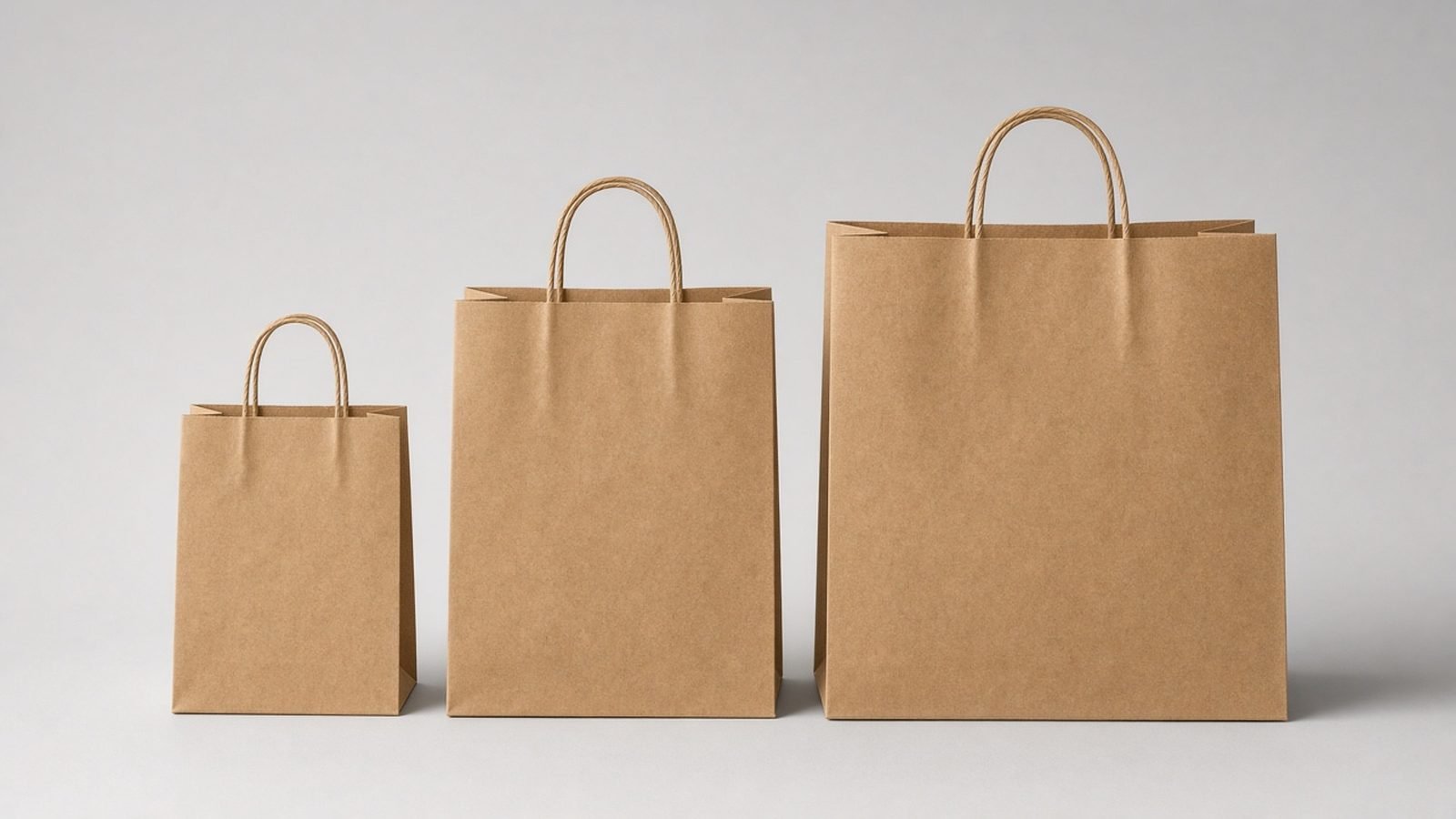
Paper bag sizes are written Width × Gusset × Height (W × G × H): width across the front panel, gusset as the depth of the side or base panel when opened, and height from base to top edge.
- Measure the packed product (in its retail box, with tissue or inserts) and add clearance for easy loading.
- Write the dimension order and units (mm or inches) on the PO.
- Confirm whether the size is internal or external, then approve a physical sample before production.
DimensionWhat it isWhere to measure Width (W)Front-panel widthLeft to right across the face of the bag, excluding the side gusset Height (H)Bag body heightBase to top edge
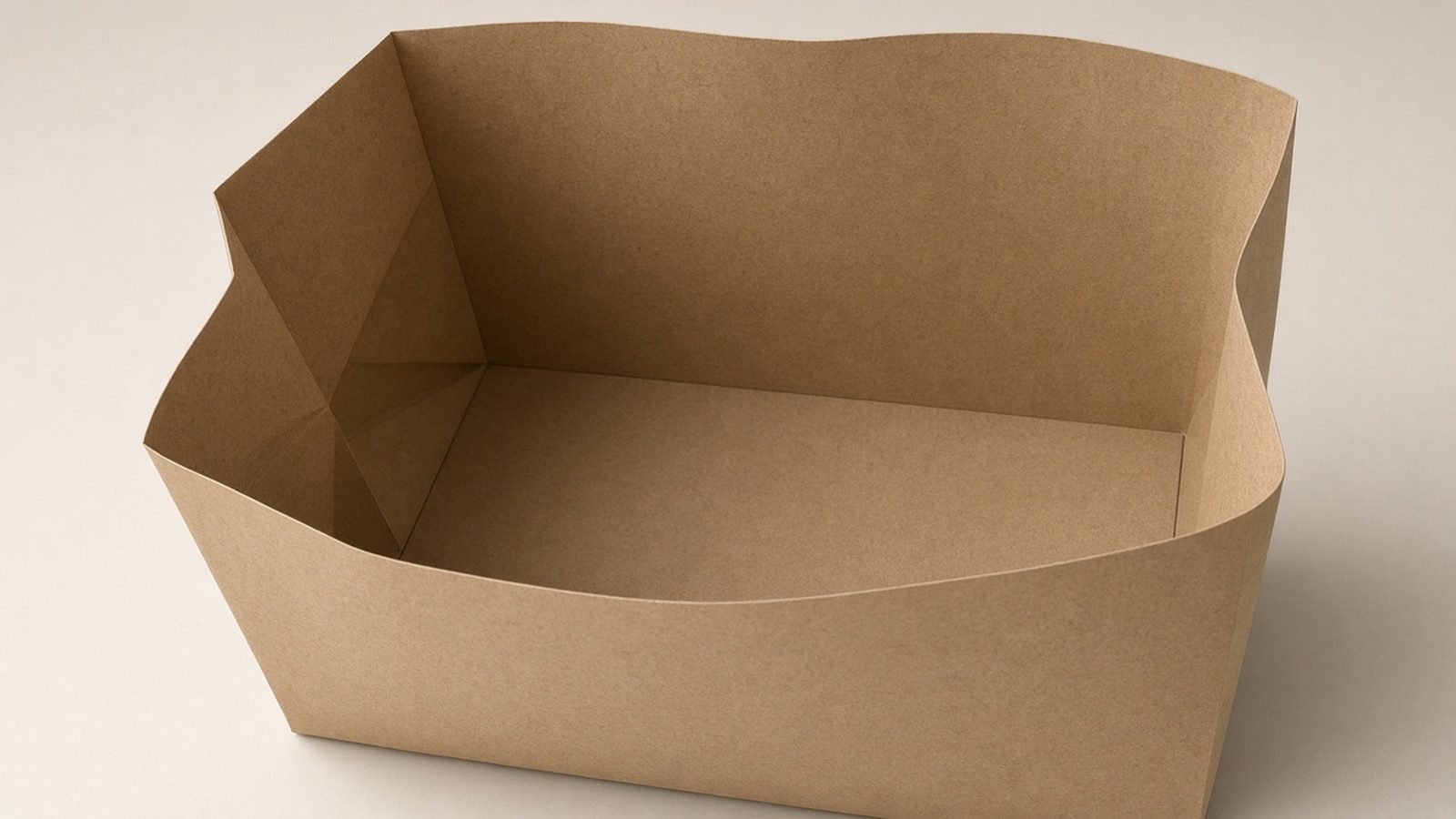
| Gusset (G), also called depth (D) | Depth of the side or base panel when opened | Open the gusset fully and measure front crease to back crease at its widest point | |
Packaging Source, Lipack, HS PACKFACTORY and Smartbag all describe these three fields in essentially this way. They differ on the order in which the numbers are written.
How to Measure a Paper Bag, Step by Step
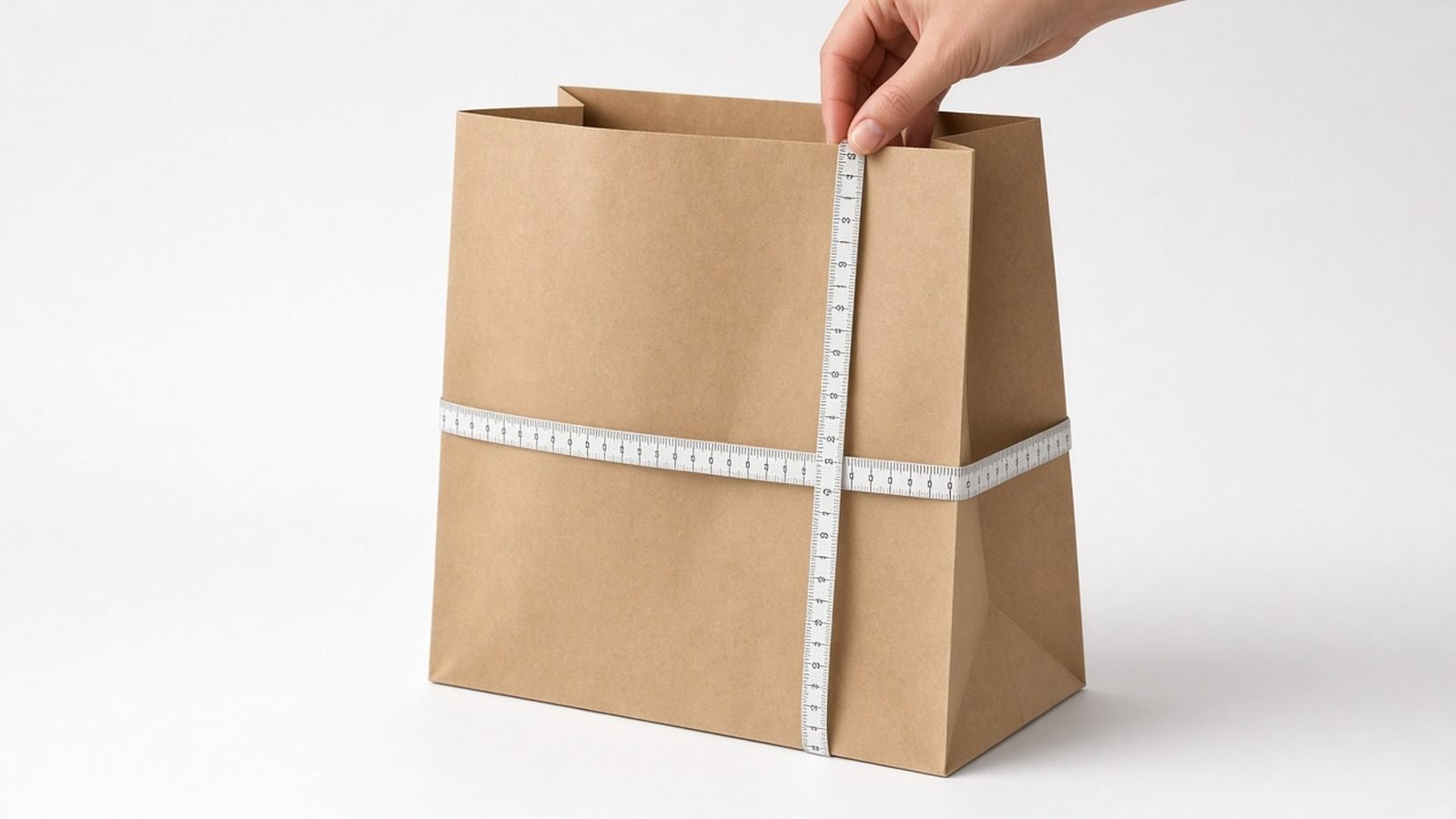
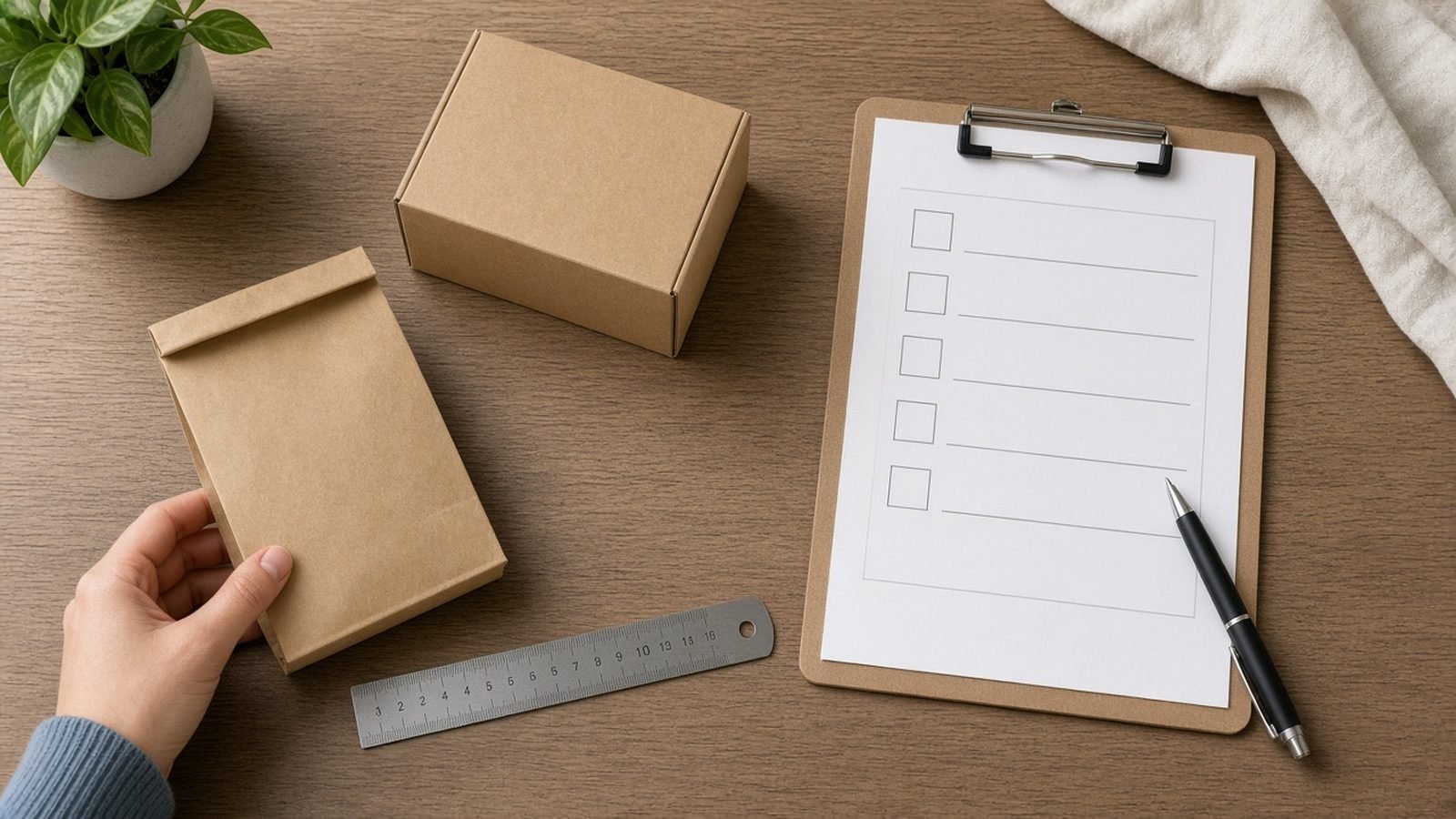
Use a flat ruler or measuring tape and measure the finished bag, not a drawing. Lipack’s guide recommends a level, straight measuring tool, and the steps below follow its approach.
- Lay the bag flat on a table with the front panel facing up.
- Measure the width across the front panel from one side edge to the other.
- Open the gusset fully so the side panel is not slack. Measure its depth from the front crease to the back crease at the widest point.
- Measure the height vertically from the base to the top edge of the bag body.
- Record all three numbers with field names and units, for example (example only) “Width 320 mm, Gusset 130 mm, Height 420 mm”.
Two cautions from the sources. First, flat bags with a sealing flap: Lipack says the flap should not be included in the height. Second, HS PACKFACTORY points out that flat size is not the same as usable internal space, because folds, seams, top turn-over and reinforcement occupy room once the bag is opened.
Dimension Order Varies by Supplier
The same three numbers can mean different bags depending on the order. Smartbag notes that W × G × H is common but that conventions vary between suppliers and even between listings, and says to never assume the order. HS PACKFACTORY lists W × D × H, W × H × D and W × G × L as other sequences in use. SourceNotation it uses or describes Packaging SourceWidth × Gusset × Height (W × G × H) HS PACKFACTORYWidth × Gusset × Height (W × G × H) as its default; notes other suppliers use W × D × H, W × H × D or W × G × L
| Lipack | Width × Depth × Height (W × D × H), also written W × G × L | ||||
| Carrierbags.co.uk (UK) | Its listing is written 320(W) × 420(L) × 130(G) mm, with field labels | ||||
| Smartbag (Australia) | Commonly W × G × H, but says some suppliers use H × W × D; it also says to confirm internal versus external measurement |
The practical rule: a size like “320 × 420 × 130” is ambiguous until the fields are labeled. State the order and the unit (mm or inches) on every RFQ, drawing, sample record and PO line.
Flat Bags, Gusseted Bags and SOS “#” Sizes
Flat merchandise bags: W × H only
Flat paper merchandise bags have no gusset, so they are measured in two numbers, Width × Height. Packaging Source gives the example of a 12 × 15 merchandise bag as 12 inches wide and 15 inches tall. Lipack makes the same point for flat bags. When a merchandise bag does have a side gusset, Packaging Source lists it as W × G × H like a shopping bag.
Side gusset vs. bottom gusset
HS PACKFACTORY notes that a side gusset expands along the side walls, while a bottom-gusset structure creates depth at the base, and that terminology varies by bag family. For sourcing, name the bag style and show where the gusset is located on a labeled drawing or sample.
SOS grocery bags: “#” sizes are labels, not dimensions
SOS (self-opening square) bags are sold by numbers such as 2#, 6# and 8#. Packaging Source describes the number as a legacy grocery trade size, not a dimension. Do not put “6#” on a custom PO as if it were a measurement. Specify the actual W × G × H, and ask your supplier to state which dimensions its own “#” labels correspond to.
How to Size a Bag for Your Product
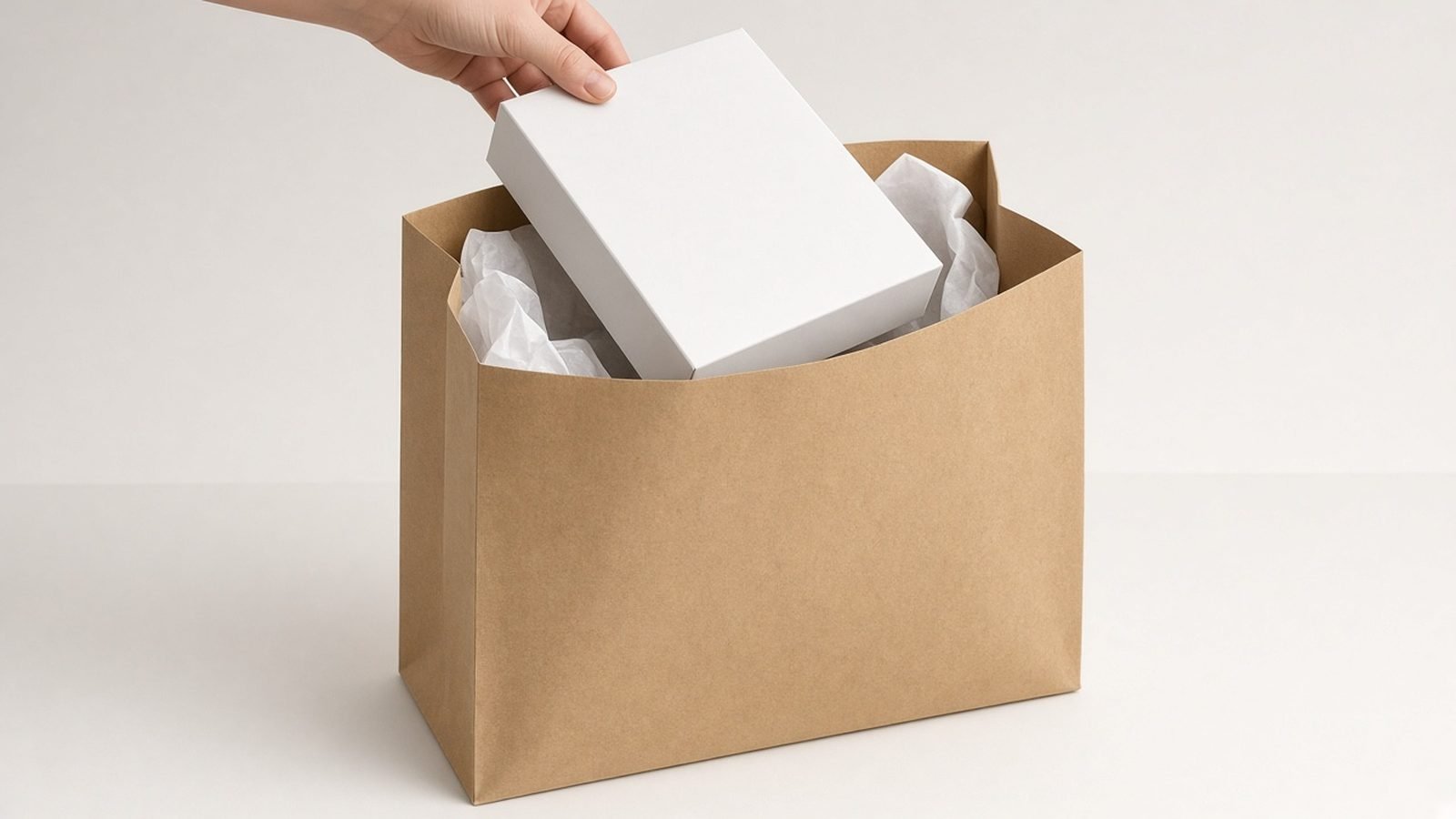
Start with the packed product, not a size chart. Smartbag’s guidance is to measure the product as it will actually be packed, in its box, with its tissue, alongside anything else that goes in the same bag. HS PACKFACTORY adds that the result is a product envelope, not the final bag size.
- Choose the carrying orientation. Decide which face points forward and which dimension becomes the gusset.
- Measure the widest point of the packed product or retail box, including lids, caps or folds that project.
- Measure the deepest point. This drives the gusset.
- Measure the highest point of the packed item, not only the product body.
- Record items per bag. One box and a stacked set of boxes have different footprints.
- Add wraps and inserts: tissue, sleeves, inner bags, pads, dividers, receipts.
- Add clearance so the product enters easily without the bag looking empty.
On clearance, both Smartbag and HS PACKFACTORY say there is no universal formula such as “add a fixed amount to every product”. A rigid boxed item needs little room, a folded soft garment needs more, and tissue-wrapped items need more again (Smartbag). Treat your first calculated size as a starting dimension and let the sample decide. For help measuring boxes accurately, see how to accurately measure box dimensions.
Too much space is also a fault: Smartbag says that if tissue is being used to stop items rattling rather than to present them, the bag is too big.
Example Sizes (for Reference Only)
These are published examples from supplier catalogs. They show how notation reads in practice; they are not recommendations for your product and not packaza specifications. Example sizeNotationSource and context 8 × 5 × 10 inW × G × HPackaging Source: its “Cub” paper shopping bag; it calls Cub and Vogue the two most popular retail bag sizes 12 × 15 inW × H (flat)Packaging Source: flat paper merchandise bag with no gusset 320 × 420 × 130 mmW × L × GCarrierbags.co.uk: twisted handle paper bag listing; the page describes it as close to A3 in portrait orientation
| 16 × 6 × 12 in | W × G × H | Packaging Source: its “Vogue” paper shopping bag, described as the classic boutique apparel bag; it also lists a euro tote in the same size | |
Reading 16 × 6 × 12: a bag 16 inches across the front, 6 inches deep when opened, and 12 inches tall (Packaging Source). Retail trade names such as “Vogue” or “Cub” are shorthand used by that supplier; always work from the dimensions.
Pre-Order Checklist for Buyers
- Internal or external size. Smartbag says this varies by supplier and listing and matters for tight fits. Ask and write it on the PO.
- Dimension order and units. State W × G × H (or the supplier’s order) with field names, in mm or inches.
- Bag style and gusset location. Side gusset, bottom gusset, flat, SOS or other, ideally on a labeled drawing.
- Product envelope. Packed product or retail box dimensions, carrying orientation, items per bag, wraps and inserts.
- Handle drop and fixing area. HS PACKFACTORY says top folds, reinforcement, handle holes and knots can reduce usable height near the opening. Confirm how much of the height is available to the product.
- Top fold. Confirm its depth and whether it is included in the stated height.
- Bottom reinforcement. Confirm whether a base pad or reinforcement is used and whether it changes usable depth.
- Tolerance. None of the sources reviewed publishes a standard tolerance. Ask your supplier for its dimensional tolerance in writing and record it on the PO.
- Sample fit test. Pack the real product in a realistic quantity, lift, carry and unpack. Smartbag and HS PACKFACTORY both recommend testing before bulk orders.
Once size is agreed, place handles, print areas and bleed on the structural file (see packaging dieline). The same spec discipline applies to boxes; see our custom mailer box specification checklist.
Common Paper Bag Sizing Mistakes
- Sending three unlabeled numbers. The factory may read a different order from the one you intended (HS PACKFACTORY).
- Measuring the bare product instead of the retail box, wrap or folded bundle.
- Ignoring the gusset. Smartbag calls it the most overlooked dimension and the most common cause of a bag that “should have fitted” but did not.
- Assuming finished height equals usable height. Top folds, reinforcement and handles take space.
- Using a stock size chart as a fit guarantee. HS PACKFACTORY notes the same nominal size can behave differently across structures and suppliers.
- Choosing size to solve a strength problem. Smartbag says a bigger bag is not automatically stronger and may encourage heavier loads.
- Skipping the physical sample before a volume order.
Paper Bag Size FAQ
How do I read a bag size like 16 × 6 × 12?
For gusseted bags written W × G × H, it means 16 wide, 6 deep when opened and 12 tall, in the unit the supplier uses (Packaging Source’s example is in inches). Confirm the supplier’s order and unit first, because other suppliers write the numbers in a different sequence.
What is a gusset on a paper bag?
The gusset is the folded side or base section that expands when the bag is opened, giving it depth. Lipack treats “depth” and “gusset” as the same dimension. It determines whether boxes, containers and thicker items fit.
How much clearance should I add around the product?
There is no universal figure. Smartbag and HS PACKFACTORY both say clearance depends on the product, bag style, paper stiffness, opening, wraps and packing method. Enough for easy loading and unloading, not so much that the product shifts. Confirm the amount with your supplier and validate it on a sample.
Does a bigger bag hold more weight?
No. Smartbag states that capacity depends on paper grade, construction, base reinforcement and handle attachment, not overall size. Check paper, handles and construction separately from size, and confirm any load requirement with your supplier.
Are paper bag sizes internal or external measurements?
It varies by supplier and listing (Smartbag). Write “internal” or “external” next to the dimensions on the PO, and have the supplier measure the sample to confirm which one the stated size refers to.