

Box dividers for packaging are internal partitions that separate multiple products inside one outer carton. They help limit product-to-product contact and organize a multipack, but they do not automatically provide enough cushioning for fragile goods. Choose the divider material, cell dimensions, height, and support system around your product and shipping route, then approve the complete packed sample before ordering.
Key Takeaways
- Specify the outer box’s usable internal dimensions, not just its external size.
- Define cell dimensions around the packed product, including any protective wrap.
- Use paperboard or corrugated board according to the required structure and performance.
- Check bottom support and vertical movement as well as side-to-side separation.
- Compare the cost per complete divider set, including assembly and packing.
- Validate the divider, outer carton, and product together.
What Do Box Dividers Do?
A partition divides the usable space inside a box into individual cells. Bottles, jars, accessories, or small cartons can sit in separate compartments rather than contacting one another. The structure may be a slotted grid or a folded one-piece construction.
Separation is different from cushioning. A divider can keep two glass jars apart while still allowing either jar to receive an impact through the bottom of the carton. Assess the whole package rather than treating separation as proof of transport protection.
Smurfit Westrock describes partitions made from paperboard or corrugated board and considers them alongside the outer packaging. That combined design approach is useful when specifying a multipack. Manufacturer reference.
A divider is one type of packaging insert. A fitted tray can hold an irregular object at specific contact points; a grid can organize several products into cells. For the wider terminology, see What Are Packaging Inserts?.
Buyer’s decision: select dividers when individual compartments serve the product and packing operation. Consider a fitted tray, cradle, or combined support system when cell walls alone cannot control the required movement.
Materials and Structure Options
Paperboard partitions
Solid paperboard provides relatively thin cell walls and can suit presentation or separation tasks. Confirm the board grade, caliper, surface finish, and stiffness needed for the project. “Cardboard” is too broad to define a purchasing specification.
Corrugated partitions
Corrugated board includes fluted material between liners. When considering it for dividers, specify the board construction and ask how it fits the available space. Thicker walls occupy more room, so changing the board can change the usable cell size.
PackMojo distinguishes folded one-piece dividers from interlocking partitions and offers paperboard and corrugated constructions. Its product guidance also links material selection to product weight, fragility, and use. Divider structures and materials.
Interlocking grids versus one-piece dividers
An interlocking grid uses strips with slots that engage during assembly. A folded structure creates compartments from a single blank. Choose between them by cell layout, assembly effort, and the sample’s behavior; neither format is universally better.
| Requirement | Starting option | Confirm before approval |
|---|---|---|
| Several similar items in repeated cells | Interlocking grid | Slot engagement, cell consistency, assembly time |
| A single row or varied compartment layout | Folded one-piece divider | Fold accuracy and usable compartment space |
| Lightweight presentation set | Paperboard structure | Stiffness, scuffing, and product retention |
| Glass multipack shipped through distribution | Corrugated partition with suitable support | Bottom protection, vertical movement, complete-pack test results |
| Irregular or highly vulnerable product | Fitted tray or engineered combined system | Contact points, cushioning, and ease of removal |
The table is a starting point for sampling, not a guarantee that a particular material will protect a product. For paperboard and corrugated differences, read Cardboard vs. Corrugated Carton Boxes.
Specify Cell Size and Divider Height
Start with the actual packed item. Include labels, handles, lids, sleeves, and any wrap that will remain around it. Record the largest product dimensions and relevant variation across SKUs.
Cell size means usable space between walls. It is different from the distance between divider centerlines. Board thickness must be accounted for when converting a cell layout into the overall grid dimensions.
Confirm these dimensions separately:
- Outer carton usable internal length, width, and height.
- Grid footprint and its fit allowance inside that carton.
- Clear length and width of each cell.
- Divider height and the positions where it separates the products.
- Any bottom pad, top pad, or additional support.
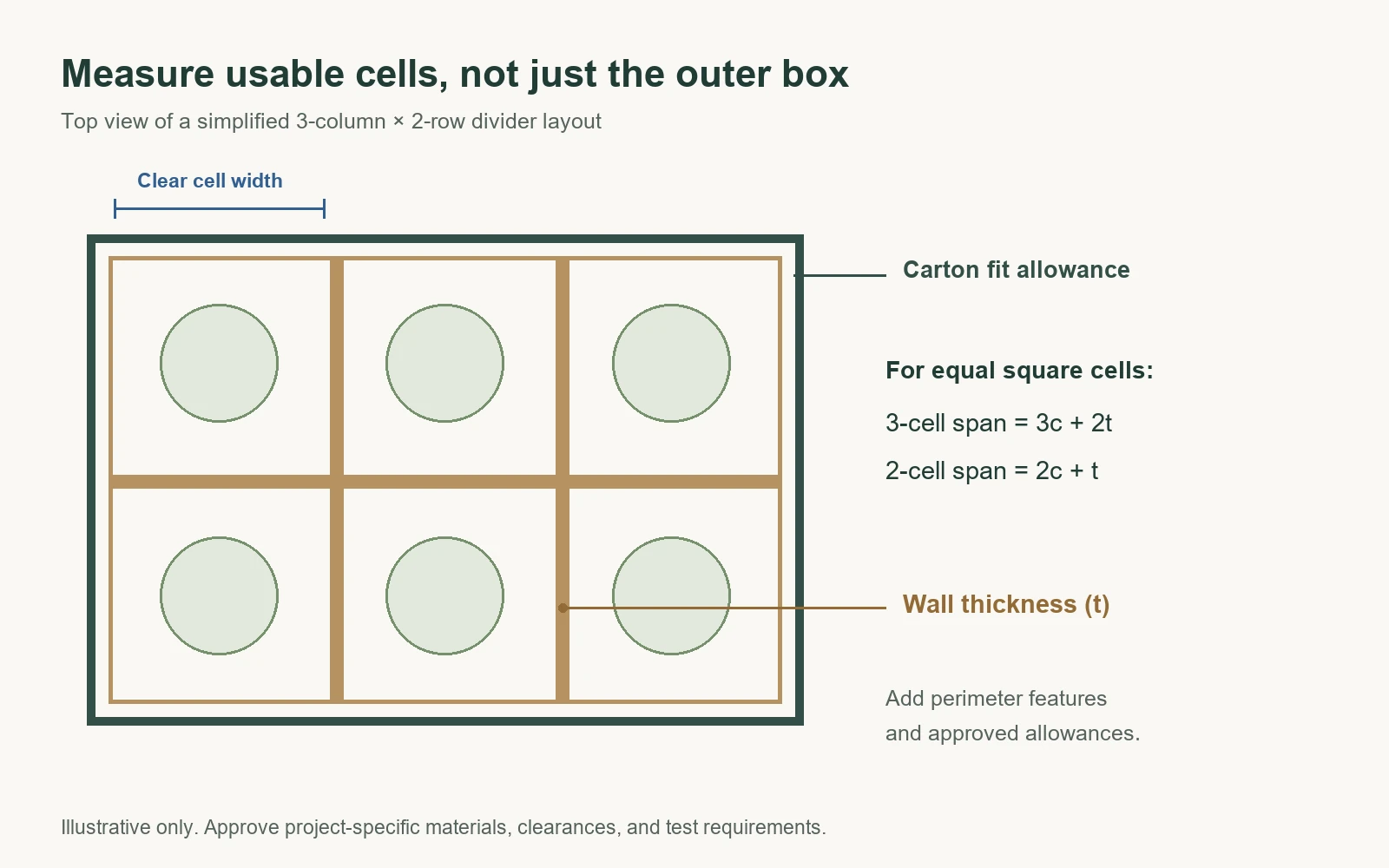
Illustrative geometry only. The production drawing must define actual materials, clearances, and tolerances.
An illustrative six-cell calculation
For an idealized three-column, two-row grid, let each clear cell be c millimetres wide and each internal wall be t millimetres thick. The internal cell-and-wall span is:
- Along three cells: 3c + 2t
- Along two cells: 2c + t
For example, if c = 70 mm and t = 3 mm, those spans are 216 mm and 143 mm. These are arithmetic examples, not recommended product clearances or final carton dimensions. Perimeter walls, folded returns, assembly geometry, manufacturing variation, and carton fit allowances still need to be considered.
Do not divide the box’s internal width by the number of cells and ignore the walls. That common mistake creates cells smaller than the intended usable space.
Height check: products can touch above a short divider even when their bases remain separated. Inspect the widest or most vulnerable contact areas, then ask whether the divider height and upper support control that risk.
How Box Dividers Are Manufactured
A typical paper-based divider project moves from a product brief to a structural drawing, sample cutting, approval, and production cutting or die cutting. Slotted strips are then supplied loose or assembled; folded structures may require creasing and, where specified, gluing.
The exact process depends on the structure and supplier. Ask whether the sample uses the intended production board and whether its cutting method represents the production result.
Manufacturing check: examine the intersection of the slots. An overly tight engagement may damage or distort the board during packing; a loose engagement may make the grid difficult to handle. Approve the fit by physical sample and an agreed specification rather than imposing a universal slot clearance.
Use the released drawing revision for both the divider and matching carton. Review Packaza’s packaging dieline approval guide before approving structural changes.
Printing and Finishing: Prioritize the Visible Surfaces
Decide which divider faces will be visible after loading. A hidden shipping partition may not need printing. A retail or gift set may benefit from product labels, color coding, or coordinated graphics.
For printed partitions, confirm the selected print route, such as offset-printed facing or another supplier-supported method. Separate instructions for foil stamping, embossing, or spot UV from the structural lines. Those finishes are optional project choices, not requirements for a divider.
Check whether printing, coatings, or adhesives affect product contact, assembly, or the requested end-of-life route. Avoid generic “fully recyclable” or “biodegradable” claims without evidence for the finished construction and intended market.
Cost Factors and Supplier Comparison
Compare a complete partition set, not an undefined “piece.” For example, a six-cell grid contains several strips; a price per strip is not directly comparable with a price per assembled grid.
| Quotation item | What to confirm |
|---|---|
| Material | Board grade, caliper, construction, and any coating |
| Set definition | Number of strips or folded components per box |
| Development and tooling | Sample fees, cutting dies, revisions, and ownership |
| Printing and finishes | Included colors, coverage, and separate setup charges |
| Assembly | Supplied flat, preassembled, or installed in the carton |
| Packing | Sets per bundle, carton protection, and labeling |
| Freight basis | Packed dimensions, gross weight, and agreed delivery terms |
There is no project-independent price or MOQ that applies to every divider. Ask for quotes at your expected order quantity and repeat-order quantity. Consider packing labor and material yield alongside the unit price. See How Much Does Custom Packaging Cost? for the wider quotation context.
Supplier question: can the supplier review the product, divider, and outer carton as one system? Smurfit Kappa’s divisions guidance explicitly connects material choice with performance requirements and supply-chain conditions. Manufacturer guidance.
Sample Checks and Transport Testing
Use the actual products and the intended packing method. Assess assembly and loading before evaluating appearance alone.
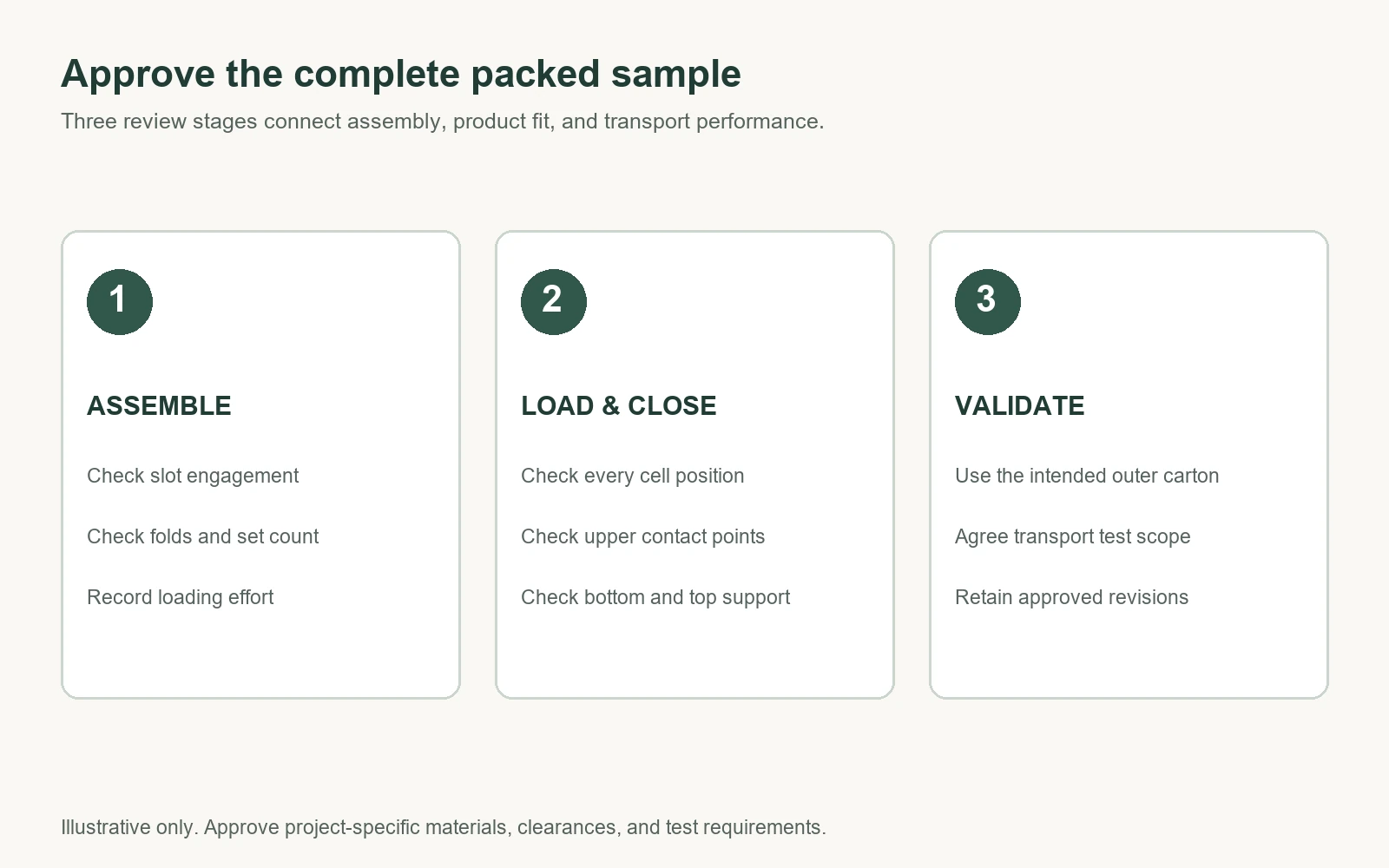
Agree on the sample specification and transport test scope before approval.
| Check | What the sample should establish |
|---|---|
| Assembly | Slots and folds engage without tearing or excessive force |
| Loading | Every intended item can be packed efficiently |
| Separation | Vulnerable surfaces remain separated at relevant heights |
| Removal | Products can be removed without damaging labels or surfaces |
| Support | Bottom, top, and side support match the product’s needs |
| Closing | The carton closes without unwanted pressure on products |
| Transport | The complete pack meets the agreed test and acceptance criteria |
QC practice: load more than one representative item into each cell position during sample review. A layout that fits one selected jar may fail when normal product variation or a different lid is introduced.
A gentle handling check can reveal obvious looseness. It does not demonstrate that the package will survive parcel transport. ISTA’s published 3A overview describes a general simulation procedure for individually packaged products moving through parcel delivery. Ask the testing provider to select the applicable current procedure and acceptance criteria for your route. ISTA procedure overview.
For repeat orders, verify the approved drawing, material, set count, packing method, and sample reference. A material substitution should trigger review of the affected fit and performance.
Packing, Freight and Ordering
Flat divider strips and preassembled grids create different packing and labor requirements. Request both options if your team can assemble grids at the packing station. Compare delivered cost and handling effort using actual packed dimensions.
Ask the supplier to label matching strip types and divider sets clearly. For a kit with several layouts, identify the corresponding SKU to reduce packing mistakes.
For carton packing and container loading, request bundle quantities, master-carton dimensions, gross weights, and pallet details where applicable. CBM is useful for shipment planning, but it does not establish container capacity or freight charges by itself.
The ordering sequence should be clear: product brief → structural proposal → quotation → physical sample → agreed testing → identified approval → production → final inspection and shipment. Confirm project-specific dates rather than relying on an assumed industry lead time.
Frequently Asked Questions
Are box dividers the same as inserts?
Dividers are a type of internal packaging. They create compartments, while fitted inserts can locate products in specially shaped cavities or supports.
Is corrugated board always better than paperboard?
No. The choice depends on space, product weight, fragility, presentation, and the complete package’s performance requirements.
Can dividers protect glass jars without other cushioning?
They may help separate jars, but additional protection can be necessary. Approve the complete pack through an appropriate sample and test process.
What dimensions should I send for a quotation?
Send packed-product dimensions, product variation, the carton’s usable internal dimensions, cell layout, and any pad or support requirements.
Should divider height equal product height?
There is no universal rule. Review possible contact areas, closure clearance, removal, and support requirements with the supplier.
Can I use one divider for several product sizes?
Only if the proposed layout satisfies each intended product. Test representative variants, including relevant dimensional extremes.
Are paper-based dividers automatically recyclable?
Do not assume so for the finished package. Coatings, mixed materials, contamination, and local collection arrangements can affect the disposal route.
Are flat dividers cheaper than assembled grids?
Compare the actual quotation, freight packing, and your assembly labor. The lowest material price does not necessarily produce the lowest delivered packing cost.
Request a Project-Specific Divider Quote
The best divider is the one that fits your product, packing station, outer carton, and distribution route. Approve those requirements together before committing to a production quantity.
Prepare this quote checklist:
- Product photos, dimensions, weight, and relevant variation
- Units per box and proposed rows, columns, or mixed cell layout
- Outer carton usable internal dimensions
- Preferred material and any printing or finishing requirements
- Bottom, top, and surface-protection requirements
- Quantity per SKU and flat or assembled supply preference
- Delivery destination, target date, and required test scope
Share the brief through Packaza’s quotation form. If the outer packaging is also being developed, include the requirements for your custom rigid boxes or shipping carton so the divider and box can be reviewed together.