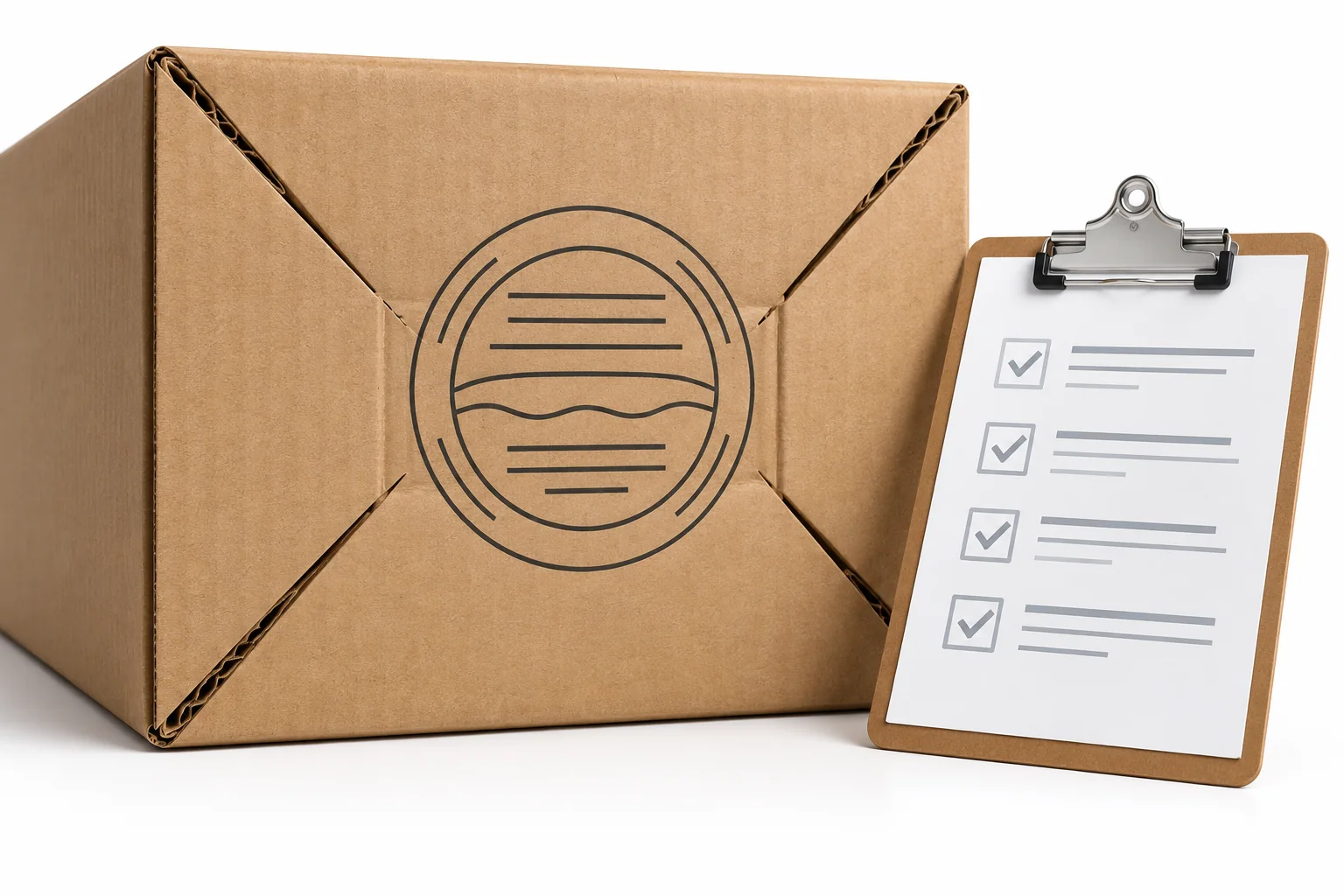
A box maker’s certificate is a mark printed on some corrugated boxes that summarizes stated construction and strength information. It can help a buyer identify a board rating, a size limit and a maximum gross weight shown on that certificate. It does not prove that a particular packed product, closure or distribution route has been validated. Read it with the product specification and acceptance evidence.
What a box maker’s certificate can show
| Certificate field | What to check | What it does not establish by itself |
|---|---|---|
| Construction | Whether the mark identifies a wall construction | Suitability for every product or route |
| ECT or burst indication | Which board-property test is stated | A finished-box compression or transit result |
| Size limit | Whether the completed box stays within the stated limit | Carrier dimensional-billing terms or every retailer rule |
| Gross-weight limit | The stated maximum gross weight associated with the mark | Product fit, internal restraint or stacked-load acceptance |
| Maker identification | Which party is identified on the mark | The buyer’s exact PO, receiving or label requirement |
Find the certificate and identify the actual box
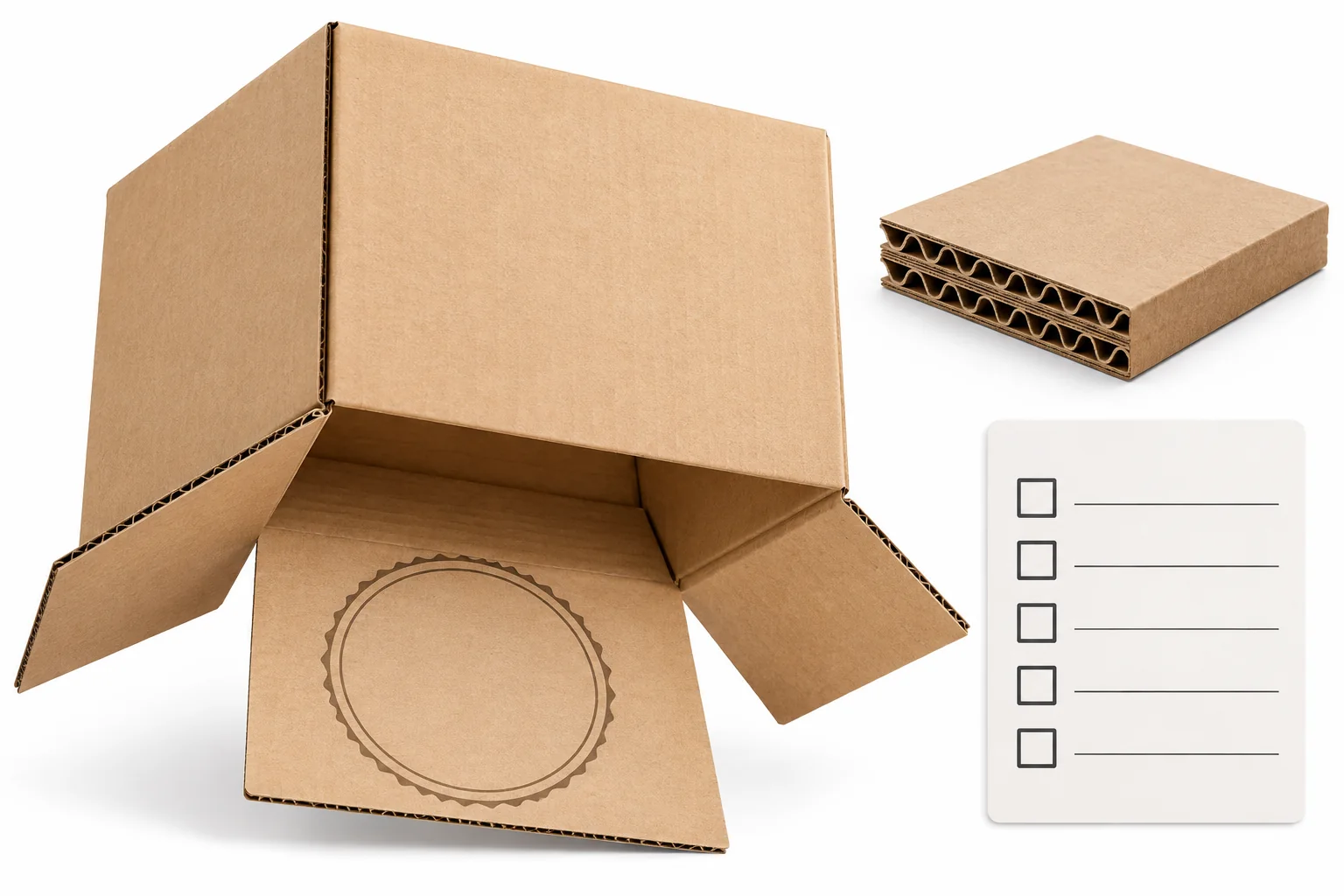
A certificate is commonly printed on an exterior panel or bottom flap. Before relying on it, make sure it belongs to the same box construction, dimensions and packed configuration you are evaluating. A photograph of a mark from another carton, sample or past order is not evidence for a different box.
Record the completed box dimensions, wall construction, closure and packed gross weight alongside the certificate. The box dimensions guide helps separate internal, external and flat dimensions.
Read ECT and burst information without treating them as equivalents
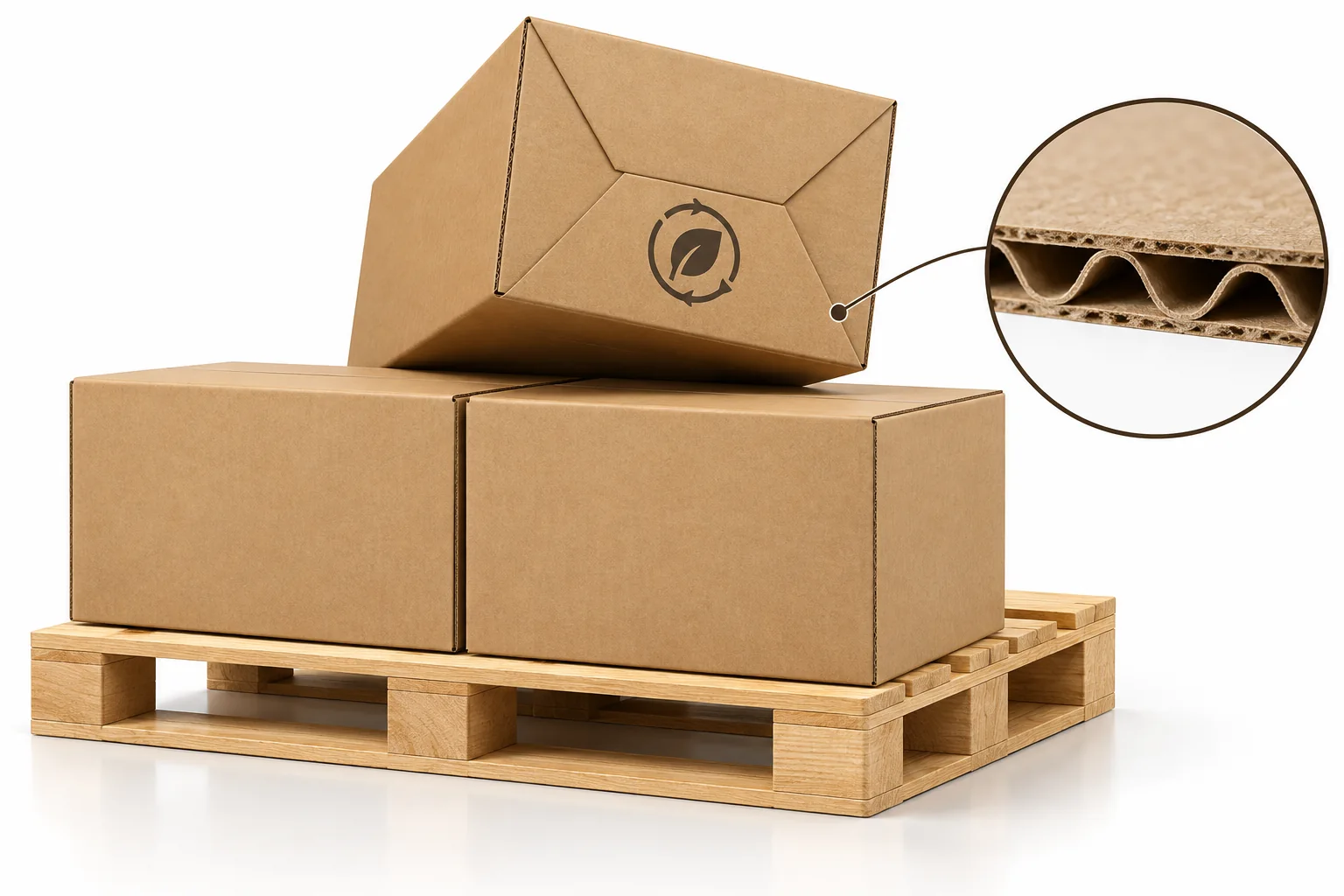
Some certificates reference ECT; others reference a burst or Mullen measure. They describe different board properties. ECT is associated with edgewise crush resistance, while burst strength concerns pressure-driven rupture through the board face.
The ECT vs burst strength guide explains what each measurement can inform and why neither establishes the complete package’s route performance. ECT vs BCT distinguishes board testing from a finished-box compression measurement.
Check gross weight and size limits against the real pack
Treat a weight or size limit as a condition that must be checked against the actual completed carton and its contents. Confirm the measurement basis, the packed gross weight, the final external dimensions and any buyer, carrier or program-specific instructions. Do not reuse a certificate value as a substitute for a current shipment’s packing list or label requirements.
| Before approval | Question to answer |
|---|---|
| Box identity | Does the certificate belong to this construction and dimension set? |
| Pack-out | Does the actual product, insert, closure and gross weight match the approved configuration? |
| Distribution | Are pallet, parcel, storage and handling conditions defined? |
| Buyer rules | Has the receiving party supplied a current carton and labeling requirement? |
| Evidence | Is a board mark sufficient, or is a structural/sample/finished-box test needed? |
When a certificate is not enough
Ask for additional evidence where the decision involves the actual finished box, product restraint or shipping route. Board markings do not capture every variable that affects a completed package.
For a distribution-test conversation, ISTA 3A for shipping boxes provides context for defining the product-pack system. For receiving and pack hierarchy, use the case pack, inner pack and master carton guide.
Common mistakes
- Reading an ECT or burst indication as a finished-box guarantee.
- Comparing gross weight without checking the actual box dimensions and construction.
- Using a certificate from a previous carton as approval for a revised dieline or pack-out.
- Confusing the certificate’s size limit with every carrier’s dimensional rule.
- Ignoring the receiving party’s current carton, marking or label instructions.
Frequently asked questions
Is a box maker’s certificate a shipping test report?
No. It identifies stated box/board information; it is not a complete report for a product-packed shipping route.
Does a certificate tell me whether the box is suitable for my product?
It can be one useful input. Product fit, contents, closure, distribution conditions and acceptance evidence still need review.
What should I request with a quote?
Request the proposed box style, dimensions, wall construction, the rating or mark being quoted, pack-out assumptions and any agreed sample or test evidence.