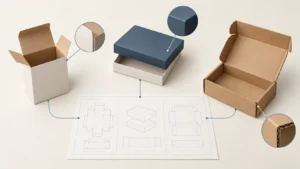

Primary, secondary and tertiary packaging describe the role each component plays in a packaging system. Primary packaging is the layer that directly contains or presents the product. Secondary packaging groups or presents one or more sell units. Tertiary packaging supports bulk handling, storage and distribution. A component’s role can change by product and channel, so use the actual pack hierarchy rather than a label alone.
Packaging levels at a glance
| Level | Main role | What to define in the brief |
|---|---|---|
| Primary | Contains or directly presents the product | Product contact needs, dimensions, closure, required visible information |
| Secondary | Groups, protects or presents sell units | Sell-unit count, orientation, structure, visible faces, opening sequence |
| Tertiary | Supports bulk handling and distribution | Case count, outer dimensions, labels, pallet and route requirements |
The GS1 trade-item implementation guide shows why the trade-item hierarchy must be treated as structured data rather than a loose set of packaging names.

Start with the actual journey
Map the product from packing through receiving, storage, shipping, retail or delivery to the final user. Ask which component touches the product, which one groups sell units, and which one is handled as the outer distribution unit. A bottle may sit in a folding carton; several cartons may sit in a tray; multiple trays may sit in an outer case. Another product may use only two layers. Do not force every project into three physical packages.
Define ownership at every level
Each level can carry different information and approval requirements. A product-facing carton may need consumer-facing artwork. A retail tray may need a defined visible face after opening. An outer case may need receiving or handling information. Keep a component-by-component register for dimensions, artwork, barcodes, labels, closure and sample status.
The case pack, inner pack and master carton guide helps define counts and carton roles. Use the shipping marks guide when outer-carton identification is part of the brief.

Keep dimension bases separate
Dimensions can refer to usable internal space, finished external size or a flat blank. State the basis for every component; otherwise a product-fit discussion can be confused with a logistics or carrier measurement. The box dimensions guide gives a shared method for recording them.
Link packaging levels to samples and approval evidence
A sample only establishes what it represents. A structural sample can help review fit and opening. A digital proof can help review artwork placement. A production-method sample can address another scope. Record which packaging level each sample represents and which conditions were not included. See the custom packaging samples guide for a practical distinction between sample types.
A quote-ready hierarchy checklist
- Identify every product, sell unit, inner pack, retail component and master carton.
- Give each component a name, part number or drawing reference.
- State product orientation and quantity at every grouping step.
- Record whether dimensions are internal, external or flat.
- Assign artwork, barcode, labels and handling marks to the correct component.
- Describe closure, opening and any separate insert or void-fill component.
- Request samples and acceptance evidence for the exact level being approved.
The custom packaging RFQ template can keep those details in one comparable request.
Common mistakes
- Calling every outer box “tertiary” without checking its actual role in the channel.
- Mixing unit, tray and master-carton dimensions in one field.
- Applying a label or barcode rule to the wrong packaging component.
- Approving product artwork without checking the assembled secondary or tertiary pack.
- Treating an individual sample as evidence for the full product-pack system.
Frequently asked questions
Is secondary packaging always a retail carton?
No. It groups or presents sell units, but the appropriate form depends on the product and channel. It may be a carton, tray, bundle or another component.
Does every product need tertiary packaging?
No. The hierarchy should describe the real system. Some channels or products may use fewer physical packaging layers.
What belongs in a packaging RFQ?
State each component’s role, dimensions, quantity, orientation, artwork or labeling input, closure, pack hierarchy, route information and approval evidence required.
Build a clearer packaging hierarchy
For a packaging inquiry, share the product and sell-unit information, every grouping layer, dimension basis, artwork and labels by component, and the sample or approval scope required. This makes supplier responses comparable without assuming unverified capability, timing or performance.