For e-commerce brands, packaging has to do more than look good. It must protect products through storage and shipping, represent the brand at the doorstep, and meet rising expectations around material use and waste. Choosing a sustainable packaging material is therefore a practical sourcing decision—not simply a marketing claim.
This guide explains how to compare common packaging materials, match them to your product and fulfilment process, and ask suppliers the questions that lead to a reliable custom packaging specification.
Start with the product and shipping journey
The most sustainable pack is one that reaches the customer intact with no unnecessary material. Before comparing materials, map the journey from packing station to customer. Note the product weight, fragility, dimensions, shipping distance, moisture exposure, and whether parcels are stacked or handled by automated equipment.
A lightweight skincare jar may need a rigid folding carton and protective insert, while glassware or electronics may require corrugated cushioning. Under-specifying the box can lead to damage and returns; over-specifying it adds cost, material, and shipping volume. The goal is the lowest-material solution that still provides dependable protection.
Compare the main sustainable packaging materials
Corrugated cardboard
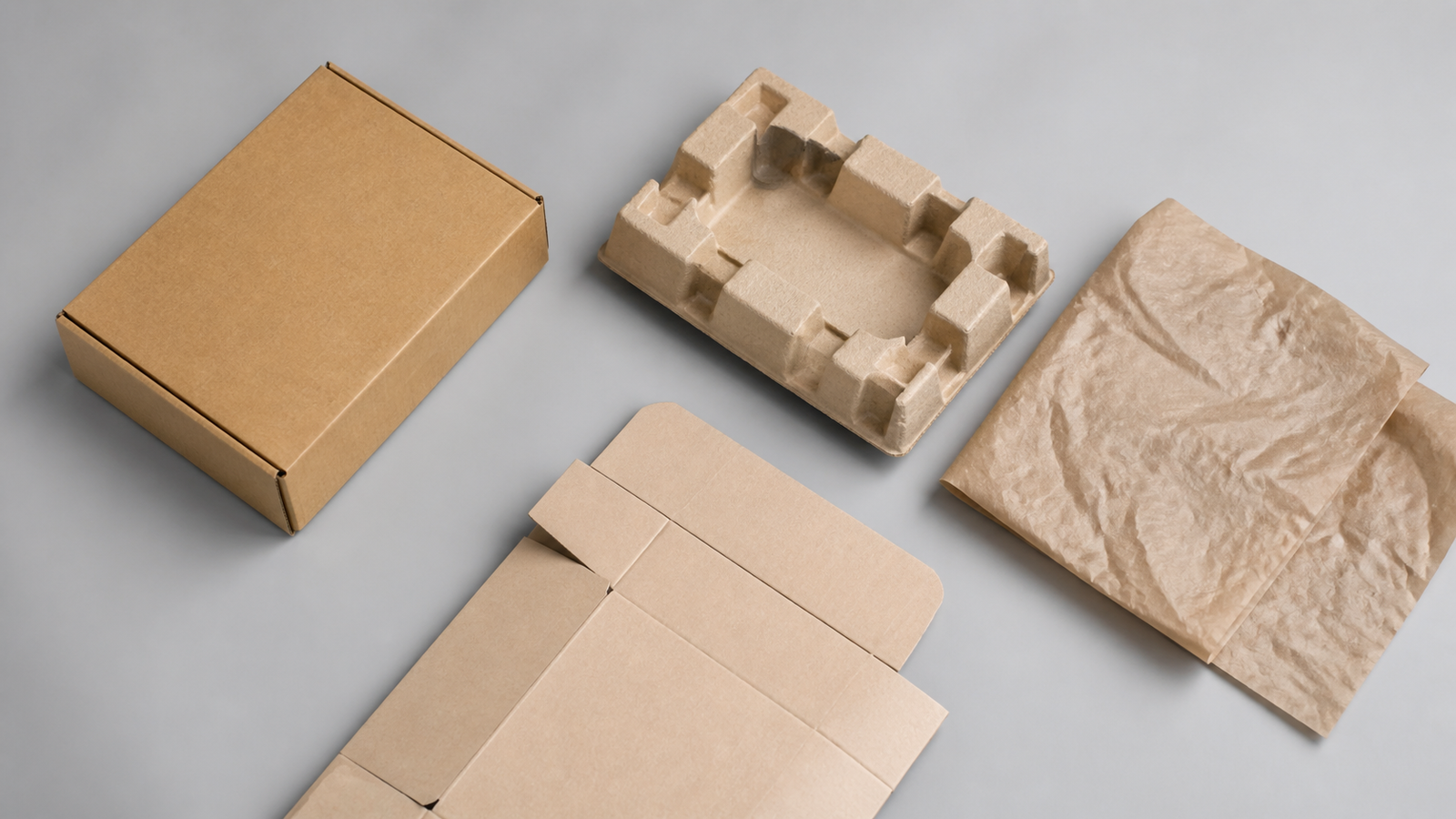
Corrugated board is a versatile option for shipping boxes, mailers, display cartons, and protective dividers. It is widely recyclable where paper recycling is available, can be made with recycled fibre, and offers a broad range of flute profiles and strength grades. For e-commerce, ask about board grade, burst or edge-crush performance, recycled content, and the right box size for your product.
Kraft paper and paperboard
Kraft paper works well for shopping bags, wrap, void fill, folding cartons, and paper mailers. Its natural appearance can support a simple, lower-ink brand presentation. Paperboard is especially useful when a product needs retail-ready graphics without the weight of a rigid box. Coatings, laminations, and mixed-material windows should be selected carefully because they may affect local recyclability.
Moulded fibre inserts
Moulded fibre is a strong candidate for holding bottles, cosmetics, electronics, and other shaped products in place. It can replace some foam inserts while providing good nesting and shock absorption. Its suitability depends on fit, moisture requirements, and surface-finish expectations. Request samples with the actual product before approving a production run.
Reusable and premium packaging
For high-value gifts, subscription products, or durable goods, a reusable rigid box or fabric pouch can be appropriate. Reuse only delivers a genuine benefit when the design is durable and likely to be kept. Avoid positioning every premium material as sustainable by default; compare its material use, transport weight, and realistic reuse case.
Look beyond the base material
A recyclable box can become harder to process if it includes multiple permanent layers, heavy plastic lamination, or difficult-to-separate accessories. Review the full bill of materials: box board, tape, labels, ink, adhesive, void fill, and inserts. Where practical, simplify the pack and use components that are easy for the customer to separate.
Printing also matters. Limit large solid ink areas when they are not needed for the brand, and work with the supplier on finishes that support the intended end-of-life route. If you use sustainability statements, make them specific and supportable—for example, describe the material or disposal guidance rather than making broad environmental claims.
Balance protection, size, and shipping efficiency
Right-sizing is one of the most effective ways to reduce packaging waste. A box that closely fits the product often needs less void fill and can reduce dimensional shipping charges. Test the packed product in realistic transit conditions instead of relying on dimensions alone. Consider how the box performs when dropped, compressed, exposed to humidity, or handled repeatedly.
For brands shipping several SKU sizes, a small family of standard box footprints with tailored inserts may be more efficient than a single oversized format. This can simplify packing operations while keeping material use under control.
Questions to ask a packaging supplier
- Which board grade and construction do you recommend for this product weight and route?
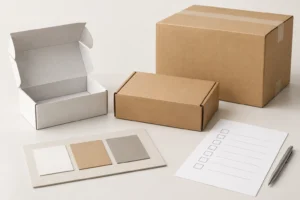
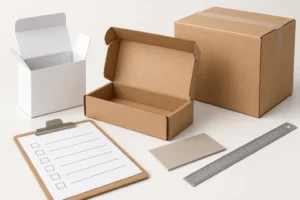
- Can you provide material samples and packed-product test samples?
- What recycled-content or fibre-source documentation is available for this material?
- Which finishes, inks, labels, and adhesives are compatible with our preferred disposal route?
- What are the minimum order quantity, lead time, and tolerance for our custom size?
- Can the structure be redesigned to reduce empty space or remove an unnecessary component?
Create a specification before you order
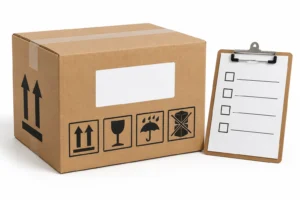
A clear specification prevents expensive misunderstandings. Include the internal dimensions, material and board grade, print requirements, finish, insert design, packing method, quantity, quality criteria, and delivery requirements. If the packaging carries disposal instructions, make sure they match the markets where your customers are located.
It is also helpful to approve a pre-production sample. This is the point to check colour, fit, opening experience, barcode position, and protection—not after a large run has been delivered.
Choose packaging that works in practice
Sustainable packaging is most effective when it combines material efficiency, product protection, operational simplicity, and clear communication to customers. Start with the actual shipping journey, then select materials and finishes that match the product rather than applying a one-size-fits-all solution.
Packaza can help businesses develop custom paper boxes, corrugated mailers, gift packaging, paper bags, and protective packaging structures tailored to product requirements. Contact our team to discuss your product dimensions, artwork, target quantity, and packaging goals.