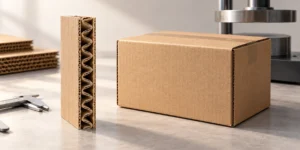

Specify a palletized corrugated box as part of a complete unit load, not as an isolated carton. Confirm the box’s outside dimensions, packed weight, pallet footprint, cases per layer, stack pattern, layers, storage time and transport route. Then test a representative packed pallet. Box-compression or ECT data alone cannot establish that a load will remain strong and stable when corners are misaligned or cartons extend beyond pallet support.
Key takeaways
- Design the box footprint and pallet pattern together before approving a dieline.
- Avoid assuming that a stronger board grade compensates for unsupported box edges.
- Compare column, interlocked and hybrid patterns for both vertical compression and load stability.
- Give the supplier the actual packed weight, layer count and pallet specification.
- Select a distribution test that reflects full-truckload, mixed LTL or another real route.
- Approve the palletized system, including wrap or other stabilization, rather than only one empty box.
Treat the pallet, box and stabilizer as one system
A purchase order for a “strong corrugated box” leaves out the conditions that determine how it will be used. Start with the actual packed product. Measure its mass and the box’s outside dimensions, then ask how many units fit on each pallet layer without protruding. Confirm the pallet’s usable top deck, not just its nominal footprint, plus any gaps beneath load-bearing box edges.
The Fibre Box Association’s pallet-pattern research describes the unit load as a combination of pallet, package and stabilizer. It examined how stack pattern changed top-to-bottom compression for particular corrugated cases. That is why the pallet drawing, box construction and stretch-wrap plan should travel together through sampling and approval.
| Buyer decision | Ask for this information | Why it matters |
|---|---|---|
| Box footprint | Outside length × width × height, including production variation | Determines cases per layer, unused space and potential overhang |
| Pallet support | Pallet type, top-deck layout and usable support area | A box edge or corner may not be supported where the drawing assumes it is |
| Layer pattern | Column-aligned, interlocked or hybrid drawing | Changes vertical load path and stability characteristics |
| Unit-load height | Cases per layer, number of layers and any double-stacking | Changes demand on lower cartons and handling clearance |
| Stabilization | Wrap, straps, corner boards or other proposed elements | The package and unit load must be evaluated as assembled |
| Route | Full truckload, LTL, warehouse transfers and retail breakdown | Guides the test procedure and handling assumptions |

Concept image only. It is not a Packaza pallet layout or a compression-test result.
Compare stack patterns without a universal winner
In an aligned column stack, box corners stay above the corners below. In an interlocked layout, the next layer changes orientation or position to tie the stack together. A hybrid combines features of both. The FBA-sponsored pattern study found aligned columns had the greatest top-to-bottom compressive resistance among the configurations it tested, while its interlocked arrangement had the lowest. It also notes that aligned loads can be unstable depending on geometry. Those results apply to the studied boxes and setup; they are not a guaranteed ranking for every product, pallet or stabilizer.
For a buyer, the useful question is: which failure are we trying to prevent? If cartons crush in the bottom layer, examine alignment, support and compression demand. If the pallet leans or shifts, examine pattern, wrap and handling. If the load is broken into mixed pallets at a distribution center, evaluate the case both in the original unit load and during later handling. The ISTA design-and-testing guide explicitly recommends understanding the distribution flow when selecting tests.
Request a drawing showing each layer, carton orientation and where the top and bottom loads meet. Ask the supplier to flag any seam, hand hole, die-cut opening or display feature that could alter the load path. For board selection, use our ECT versus BCT guide as a starting point, then validate the finished unit load. A board measurement and a palletized-system test answer different questions.
Check overhang and support at the edges
Overhang means a carton extends beyond its supporting pallet or lower layer. It can occur on one side, at a corner or because the loaded pallet is not assembled as drawn. The FBA and ICPF overhang study found that effective box compression decreased as overhang increased in the configurations it tested. The size of the effect depended on box dimensions, board type and where the overhang occurred. There is no defensible single percentage to deduct from every quote.
Inspect the real pallet, including top-deck gaps and damaged boards. Check the first layer before adding more cartons. If a proposed box arrangement creates overhang, revisit carton dimensions, the number of cases per layer, pallet selection or the layer pattern. A heavier board grade may be one option, but it should not be the automatic fix for a preventable support problem.

Concept procurement scene; no dimension, tolerance or pallet performance is certified by this image.
Choose the test for the route and acceptance question
Ask what the test must decide: carton compression, unit-load integrity, impact resistance or load stability. ISTA’s procedure overview describes 3E for unitized loads of similar packaged products in full-truckload distribution and 3B for LTL environments that can include palletized loads. These are different distribution models. The ISTA design guide notes that when a pallet is broken down, an individual-package test may also be relevant. Agree on the current procedure edition with the lab and record any retailer-specific requirement.
Do not treat “passed ISTA” as a complete specification. Record the exact packed product or representative substitute, box and pallet build, stacking pattern, stabilizer, conditioning, test sequence, sample count and pass/fail criteria. If the shipment changes from full pallets to mixed parcels, reassess the test plan. Laboratory results help reduce risk, but track damage and lean in actual shipments as feedback for the next design.
The FBA pallet-pattern study used a controlled loaded-box configuration for unit-load compression. Its method illustrates why a loose flat blank or empty sample is not interchangeable with a representative shipped unit. For wider box-style decisions, see the corrugated-versus-cardboard guide.
Send the same palletization RFQ to every supplier
Include these inputs so quotes and samples can be compared:
- Product size, packed weight, fragility and whether its contents support the carton walls or top.
- Box style, inside and outside dimensions, closure, inserts, print and any cutouts.
- Proposed board construction and what test evidence is available for that exact construction.
- Pallet size and type, usable top-deck support, entry orientation and condition requirements.
- Cases per layer, number of layers, layer-by-layer pattern and permitted dimensional variation.
- Stabilization method, including wrap, straps, edge protection or slip sheets if used.
- Storage duration, expected climate, vehicle type, transfers and whether loads will be stacked on top.
- Test procedure and edition, test configuration, acceptance criteria and approval responsibility.
Ask Packaza about a custom corrugated box using your box and pallet drawings. We can discuss a sample specification and the information needed for a verification plan; any performance claim should be tied to the tested configuration. The custom mailer-box checklist can help organize a related small-parcel brief, but a pallet-load brief must also describe the unitization system.
Frequently asked questions
Is column stacking always better than interlocking?
No. Column alignment favored vertical compression in one FBA-sponsored study, but the same source notes that geometry can make an aligned stack less stable. Evaluate the whole unit load and its route.
Can I allow boxes to overhang the pallet slightly?
Do not choose a universal allowance. Assess the exact overhang location and distance, board, carton dimensions, packed load and test result. First ask whether the footprint can be corrected.
Does a higher ECT rating solve pallet damage?
Not necessarily. ECT measures board edge-crush performance. Pallet support, box geometry, assembly, humidity, duration and load pattern still influence the outcome.
Should the sample pallet be wrapped before testing?
If wrapping is part of the shipped configuration, include and document it in a representative system test. The test plan should reflect the actual stabilizer and application method.
Which ISTA procedure applies to full-truckload pallets?
ISTA lists 3E for similar packaged products in unitized full-truckload shipment. The appropriate procedure still depends on the real distribution path and current test edition.
What changes if the shipment moves through LTL?
Mixed freight and additional handling may change the hazards. ISTA lists 3B for LTL, including certain palletized or skidded shipments. Confirm the specific test configuration with a qualified lab.
Do I need a box-compression test and a unit-load test?
They answer different questions. Box compression characterizes a finished carton under stated conditions; a unit-load test examines the assembled pallet system. Choose both when the decision requires both kinds of evidence.
What should I ask for before approving mass production?
Approve a physical carton sample, the pallet pattern drawing, full pack-out, stabilization method and agreed test report. Require review if any of those change after approval.