
Void fill packaging occupies unused space inside a shipping carton to limit product movement. Choose it according to the packed product, remaining gaps, packing process and distribution conditions. Paper, air pillows and loose fill serve different applications; none automatically replaces a cushioning system. Start with an appropriately sized carton, define the protection needed, then validate the complete packed configuration before ordering materials in volume.
Key takeaways
- Reduce unnecessary carton space before adding more filler.
- Separate movement control from shock cushioning and surface protection.
- Compare materials in the actual packed configuration, not by appearance alone.
- Measure cost per completed order, including labor, storage and freight.
- Specify material grade, pack instructions and approved substitutions.
- Check the product after agreed distribution testing; a quiet box is not proof of protection.
- Base disposal claims on the specific material and destination collection system.
Contents
- What is void fill packaging?
- Void fill, cushioning or a fitted insert?
- Which materials should you compare?
- How should you size and fill the carton?
- How does the packing process affect selection?
- What about printing and presentation?
- What drives cost per packed order?
- How do you validate quality and choose suppliers?
- Frequently asked questions
- Prepare a quote request
What is void fill packaging?
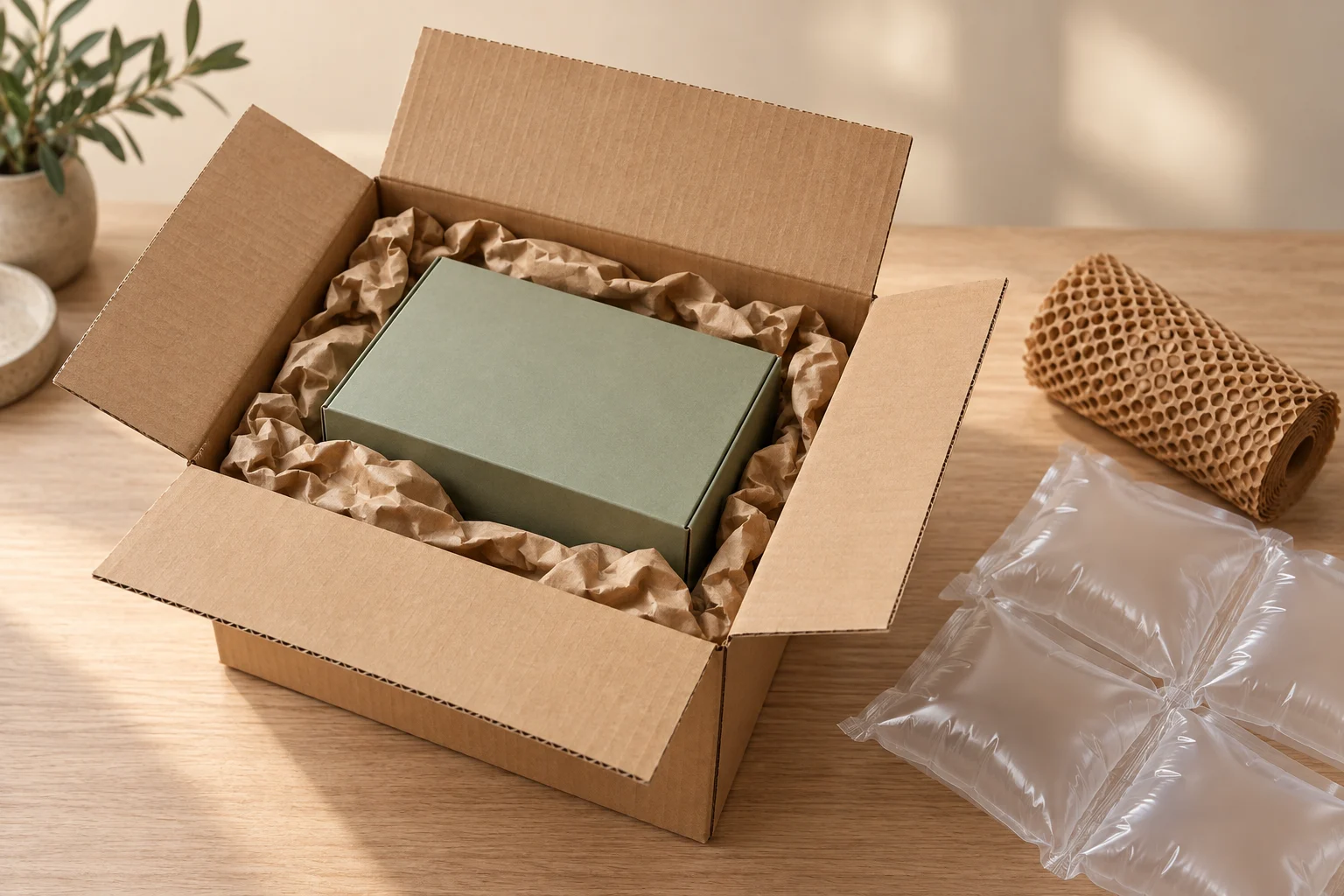
Void fill is internal packing material used to occupy gaps around products in a carton. Its main purpose is to reduce unwanted movement during handling. It may be dispensed as crumpled paper, inflated pillows or loose material, depending on the application.
The word “fill” can hide an important design question: what does the product actually need? A sturdy retail carton may need only movement control inside its shipping box. A fragile object may need an engineered cushion, surface protection and a defined separation from the outer walls as well.
Do not select filler solely because it makes the carton look full. Review the product, carton and internal packing as a system. If the outer box is much larger than necessary, changing its size may be more useful than increasing filler consumption.
Void fill, cushioning or a fitted insert?
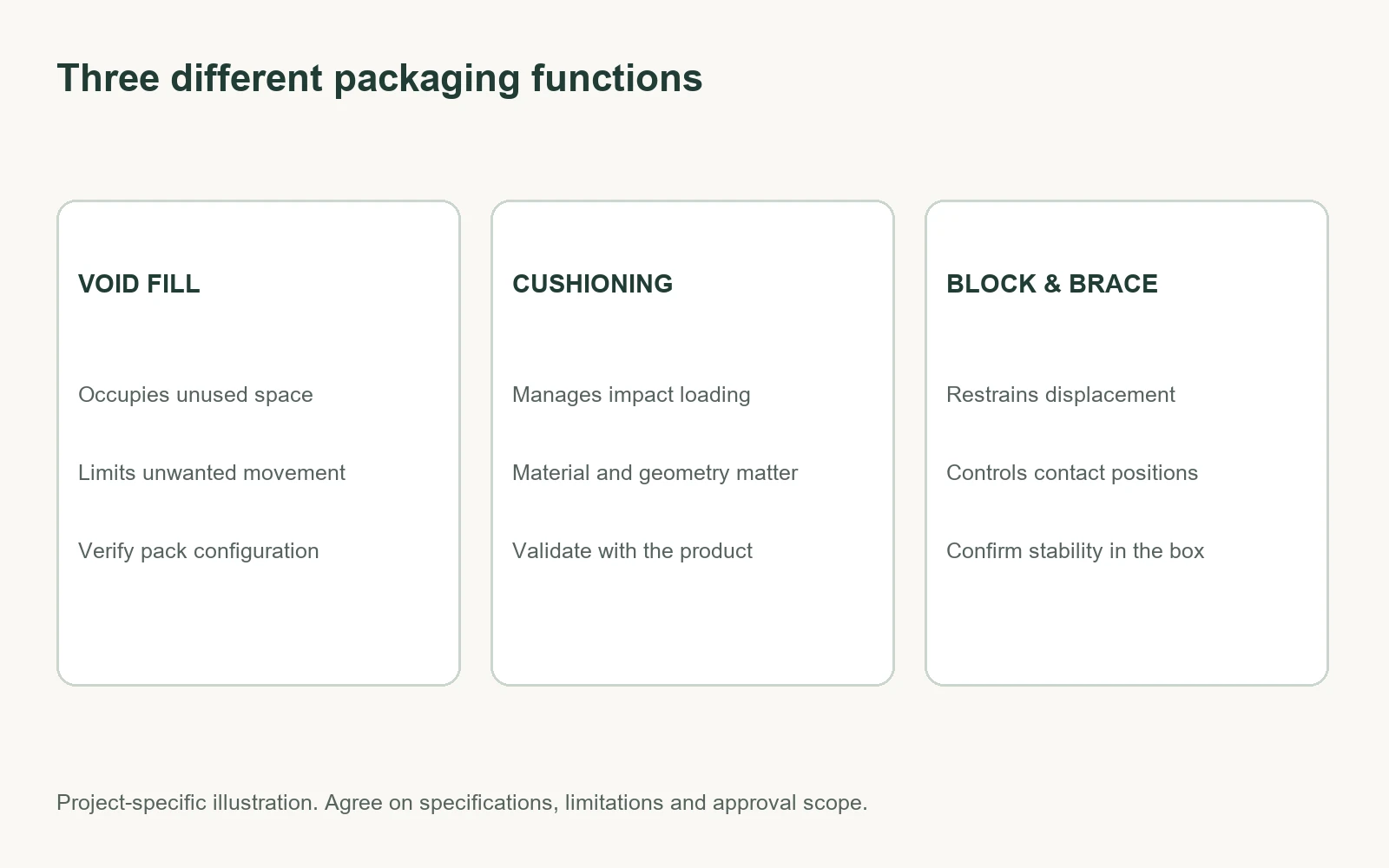
These functions overlap, but they are not interchangeable. Void fill occupies space. Cushioning manages impact through an appropriate material and geometry. Blocking and bracing restrain movement. Surface protection separates vulnerable finishes from abrasive contact.
For example, an air pillow offered for filling gaps should not automatically be specified as a cushion for a heavy object. Sealed Air distinguishes inflatable void-fill and cushioning products. Ask suppliers which function their proposed material is intended to perform, and under which loading conditions.
A fitted insert can organize components and create repeatable placement. Loose filler is often more adaptable to changing order contents. Neither choice guarantees protection without reviewing the full pack. For shaped gift packaging, use the existing rigid box insert guide to compare fitted materials.
Selection rule: define the failure you want to prevent first. Movement, impact, product-to-product contact and scratching can require different measures. “Add more paper” is not a complete specification.
Which void fill materials should you compare?
Use the table to shortlist options for trials. It describes buying considerations rather than guaranteed performance rankings.
| Material or format | Why buyers consider it | What to verify in a trial |
|---|---|---|
| Crumpled kraft paper | Adaptable gap filling and a paper presentation | Paper grade, formed shape, amount used and movement after handling |
| Engineered paper pads | More defined support than loosely placed sheets | Pad geometry, loading direction, placement and compression behavior |
| Inflatable air pillows | Material can be stored before inflation; flexible gap filling | Film specification, seal integrity, puncture exposure and product suitability |
| Loose fill | Can occupy irregular spaces around an item | Settling, migration, removal effort and suitability for the product |
| Honeycomb paper wrap | Surface separation and wrapping presentation | Coverage, snagging, compression and whether separate void fill is needed |
| Corrugated pads or blocks | Defined spacing or restraint when designed appropriately | Grade, orientation, contact points and stability inside the carton |
Paper products are not all equivalent. Sheet weight, width, recycled content, moisture condition and the way a dispenser forms the material can affect handling and packing. For pads, specify the approved product and formed configuration rather than ordering only “kraft paper.”
Air systems also differ. Confirm film dimensions, pillow format, equipment compatibility and the supplier’s intended use. Inspect sharp edges and other contact points that could damage the inflated material.
Loose fill deserves a practical opening trial. Can customers remove it without scattering material? Could it enter product openings or interfere with accessories? Its ability to occupy space does not answer those questions.
For paper wraps and printed tissue, distinguish presentation from protection. A neat wrap can prevent some direct contact, but it does not establish adequate impact protection. Ask for material-specific evidence and test the configuration that will actually ship.
Avoid blanket environmental labels. Paper, film and loose-fill products vary in coatings, additives and local collection options. Obtain composition information and applicable disposal guidance before making claims about the delivered pack.
How should you size and fill the carton?
Measure the complete order: product, retail packaging, accessories and any required protective elements. Specify usable internal dimensions and include the space required by the proposed protection system. Choosing a tight carton that removes necessary cushioning space can create another problem.
Review gaps above, below and beside the item. Top fill alone may leave movement elsewhere. For multi-item orders, separate contact-prone surfaces and consider how the arrangement changes when the carton is handled in another orientation.
There is no universal filler percentage or clearance suitable for every product. Heavy, fragile, irregular and surface-sensitive products impose different requirements. Ask a qualified packaging supplier to propose the configuration against a defined product and distribution brief.
Load and close the carton without forcing the flaps. Overpacking can distort the box, make closure inconsistent or press on vulnerable product features. Underpacking can leave room for displacement. Record the intended placement and amount after a successful trial.
An informal movement check helps identify obvious gaps, but do not use “no rattle” as the final acceptance criterion. A product can be immobilized and still be poorly protected from impact. If multiple items need dedicated compartments, compare packaging inserts rather than relying on filler between them.
How does the packing process affect selection?
Test the material at the packing station. Include receiving, storage, replenishment, dispensing, loading, closure and cleanup. A material that performs well in a one-off sample may be difficult to use consistently during a busy shift.
For paper systems, ask how the equipment forms the paper and which consumables it accepts. For inflatable systems, confirm setup, seal quality checks, power needs, maintenance and replacement-film availability. Do not assume films or paper products from another source are approved substitutes.
Compare packing instructions across different order sizes. A changing product mix may need several standard pack configurations rather than one vague instruction to “fill the gaps.” Mark where protective components go and how the carton should close.
For custom corrugated blocks, pads or dividers, agree on die-cut geometry, fold direction and assembly requirements. Require a revision-controlled drawing. The packaging dieline guide explains the drawing details to check before tooling or ordering a new structure.
Practical production check: trial the configuration with the people who will pack orders. Record material consumption and packing time over representative orders, and inspect whether different operators achieve the same placement. Use those findings to refine instructions.
What about printing and presentation?
Unboxing matters, especially when a shipping carton contains a branded gift box. Choose a presentation that allows the customer to find and remove the product easily. Keep filler away from opening features, accessories and information that must remain visible.
Printed tissue or branded paper can carry artwork, but confirm print legibility on the intended stock and behavior where sheets fold or rub against products. Request a physical sample if transfer, abrasion or contact with a delicate finish is a concern.
Do not add lamination, foil or other decoration simply to the filler specification without considering its purpose and disposal implications. High-value finishes may be better evaluated on the presentation box while the outer pack performs the shipping function.
If a rigid box is part of the order, compare custom rigid box formats and the rigid packaging guide. Then design the surrounding shipping pack for that actual box and contents.
What drives cost per packed order?
Compare complete operating cost instead of the price per roll, bag or sheet. Include material consumption, packing time, equipment, storage and freight. An inexpensive consumable can become costly if it requires more material or creates a slower packing step.
| Cost component | What to measure or request | Comparison mistake to avoid |
|---|---|---|
| Consumables | Actual amount used per representative order | Comparing roll prices without usable yield |
| Packing labor | Time for dispensing, placing, closing and cleanup | Timing only the dispensing step |
| Equipment | Purchase or rental terms, service and consumable restrictions | Treating equipment provision as unconditional |
| Storage and inbound freight | Delivered pack size, replenishment frequency and usable stock | Ignoring space for expanded materials |
| Outbound freight | Closed-carton dimensions and weight under the carrier’s terms | Assuming filler weight is the only freight factor |
| Quality and returns | Damage observations, rework and claims records | Claiming savings from an unvalidated sample |
Use a simple starting calculation: consumable cost per order plus labor time multiplied by the applicable labor cost per unit of time. Add equipment and other allocated costs consistently when comparing alternatives. Keep the assumptions visible.
Record closed-carton dimensions when estimating outbound freight. Carrier charging rules vary, so use the actual service and account terms. For carton packing and container loading, review the outer shipping dimensions and total CBM rather than assuming a change in filler alone will reduce the shipment volume.
Request trials before buying a large quantity. The custom packaging cost guide provides broader order factors to include with the internal packing budget.
How do you validate quality and choose suppliers?
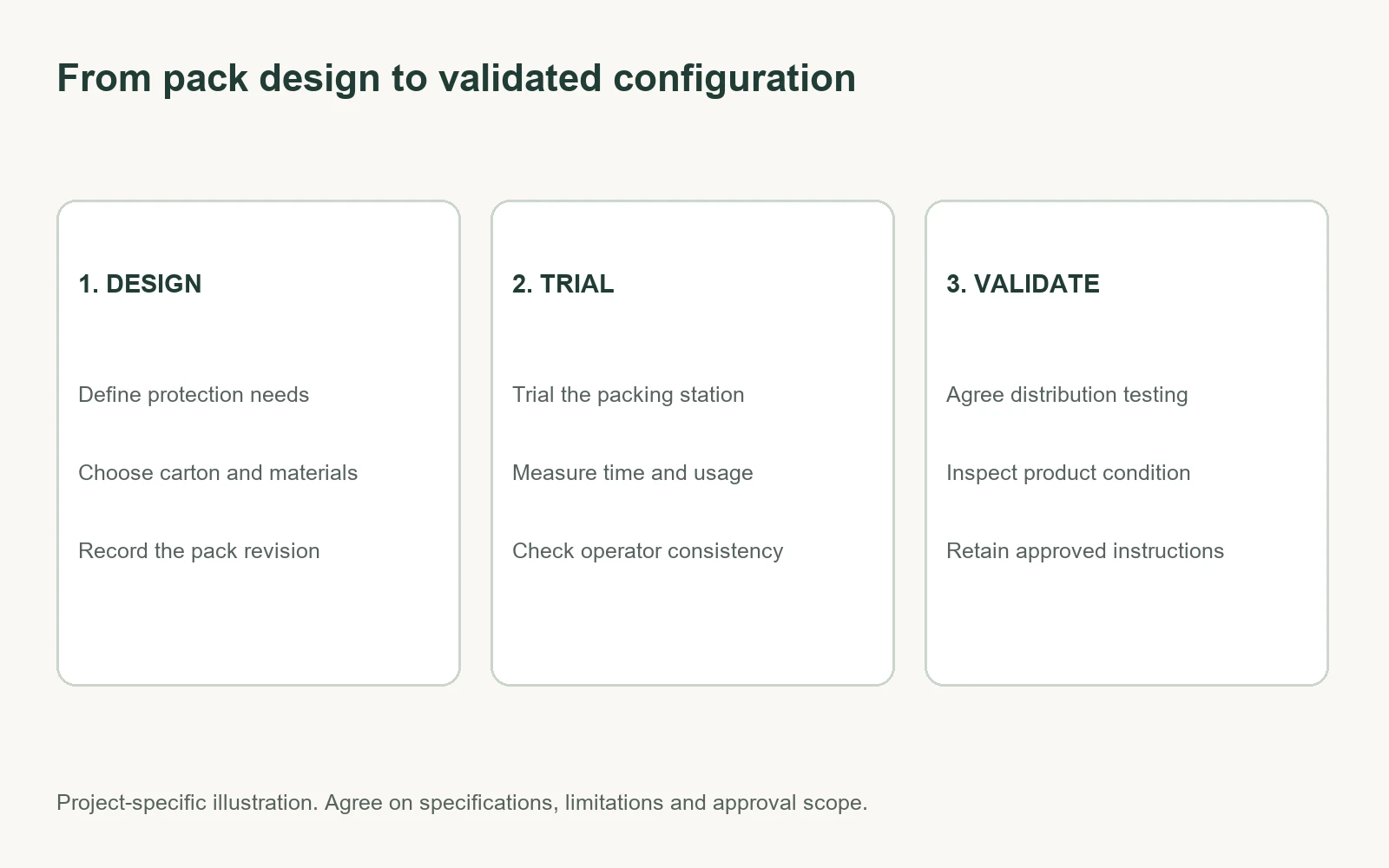
Define what a successful delivery means before testing: acceptable product condition, functional checks, cosmetic limits and packaging condition. Agree on the distribution environment and testing scope with the supplier or a competent laboratory.
ISTA’s design and testing guidance discusses pre-shipment distribution testing as a tool for understanding packaged-product performance. Select an appropriate procedure for the actual application with the laboratory; do not claim certification from an informal shake or drop check.
Test the complete product-package combination with the intended filler, carton, closure and product quantity. Afterward, inspect the product as well as the outer box. A carton can look acceptable while the product has suffered internal damage.
| Checkpoint | Evidence to retain | Supplier question |
|---|---|---|
| Material identity | Grade or product code and technical specification | What changes require notification? |
| Packing consistency | Approved instructions, photos and consumption records | How is the configuration reproduced? |
| Sample and test results | Product version, pack revision and acceptance criteria | Does this evidence cover the proposed use? |
| Production supply | Incoming checks and approved substitution rules | How are lots and specification changes identified? |
| Equipment support | Operating instructions and service terms | What support and compatible consumables are available? |
Revisit the configuration when the product, carton, material or distribution route changes. A past result applies to the tested configuration, not automatically to every variation.
Select suppliers who describe limitations, support practical trials and provide clear specifications. Compare proposals against the same brief. Do not infer product suitability from a general portfolio photograph or an unrelated certificate.
Frequently asked questions
Is void fill the same as cushioning?
No. Filling space and managing impact are different functions. Some systems support both, but the material and configuration must suit the product and loading conditions.
Is paper always better than air pillows?
There is no universal winner. Compare movement control, product sensitivity, packing time, storage, consumption and disposal options using the actual order configuration.
How much void fill should I use?
Use an approved pack configuration rather than a universal percentage. Establish placement and consumption through representative trials and appropriate validation.
Can I replace a custom insert with loose filler?
Sometimes a different internal pack is workable, but it changes product placement and restraint. Reassess contact, protection, opening experience and packing consistency before approving the substitution.
Does a shake test prove shipping protection?
No. It can reveal obvious movement. It does not establish resistance to the full set of distribution hazards or demonstrate formal test compliance.
Can I print my logo on void fill paper?
Ask the supplier about the specific stock and printing process. Review a sample for readability, transfer and contact with your product, and confirm the order quantity and cost.
Are void fill materials recyclable?
Disposal depends on the specific material, contamination, coatings and local collection system. Obtain product-specific information and use guidance appropriate to the destination.
What should be included in a supplier quotation?
Request the material specification, usable quantity, equipment terms if applicable, sample or trial scope, delivery charges, lead time and approved substitution policy.
Prepare a void fill packaging quote request
For a useful inquiry, provide:
- Product dimensions, weight, fragility and sensitive surfaces.
- Retail packaging, accessories and order combinations.
- Proposed shipping carton’s usable internal and external dimensions.
- Distribution method and destination markets.
- Monthly demand and expected packing-station throughput.
- Desired material formats and any equipment constraints.
- Presentation requirements and product-specific disposal information needed.
- Trial quantities, validation requirements and target delivery date.
Send the brief through Packaza’s inquiry form to discuss the carton and internal packing requirements. Ask for a clearly specified proposal and a representative sample configuration before committing to bulk supply. Match the filler to its required function, document the pack, and validate the complete order rather than judging protection from appearance alone.