Rigid box vs folding carton is a choice between a formed presentation pack and a flat-shipped retail pack. Choose a rigid box when opening experience and lasting presentation justify thicker wrapped board, assembly work and higher freight volume. Choose a folding carton when light weight, flat storage and efficient high-volume filling matter more. Neither format alone guarantees transit protection: test the product, insert, retail box and outer shipper together before bulk production.
Key takeaways
- A rigid box is normally supplied already formed; a folding carton is usually supplied flat and erected before filling.
- The biggest landed-cost difference may come from shipping volume and packing labor, not only the quoted box price.
- Both formats can use attractive print, foil and embossing; the same finish behaves differently on a wrapped box and a scored carton.
- For fragile products, compare the complete protective pack instead of assuming the thicker box is sufficient.
- Approve samples with actual products, inserts and closure methods.
- Give both suppliers the same RFQ assumptions, destination and Incoterm to obtain comparable offers.
What are rigid boxes and folding cartons?
A rigid box, or set-up box, typically uses thick greyboard or chipboard as a formed core. Printed or specialty paper wraps the exterior. Common structures include lid-and-base, drawer, book-style and magnetic boxes. It tends to retain its shape when empty and is often selected for premium gifts, jewelry, fragrances and presentation kits.
A folding carton is cut, scored and often side-seam glued from a printable paperboard sheet. It travels flat, then folds into a retail pack at the filling line or packing table. Tuck-end cartons, sleeves, crash-lock bottoms and seal-end cartons solve different loading and closure needs. The term refers to the structure, not a low-quality finish: a carefully specified carton can look premium.
Packaza’s complete rigid box guide covers the wider range of rigid styles. Its paperboard grades guide helps buyers distinguish board choices for carton work.
Rigid box vs folding carton: buyer comparison
| Decision factor | Rigid box | Folding carton | What to verify |
|---|---|---|---|
| Construction | Formed thick board, usually paper wrapped | Cut and scored single sheet, often glued at a seam | Finished dimensions, opening and closure |
| Inbound freight/storage | Usually occupies its finished volume | Usually stacks flat before erection | Master-carton size, total CBM and warehouse space |
| Packing operation | Ready to fill, but inserts and lids can add handling | Requires erection or a filling machine | Actual units per labor hour with the real product |
| Presentation | Substantial formed feel and reusable appearance | Lightweight shelf pack with broad graphic area | Sample at retail viewing distance and in hand |
| Protection | Stiff retail shell, still needs transit design | Less inherent stiffness, may work with insert and shipper | Loaded handling and distribution test |
| Price drivers | Board, wrap, finishing, manual assembly, insert | Board grade, print, die, gluing, erection | Total delivered cost per saleable packed unit |
See the structural difference in real product photos
The blue lid-and-base box below is a formed rigid gift box with a fitted interior. Its separate lid and base already hold their shape. The photographed packaging is an example of the structure, not a strength-test result.

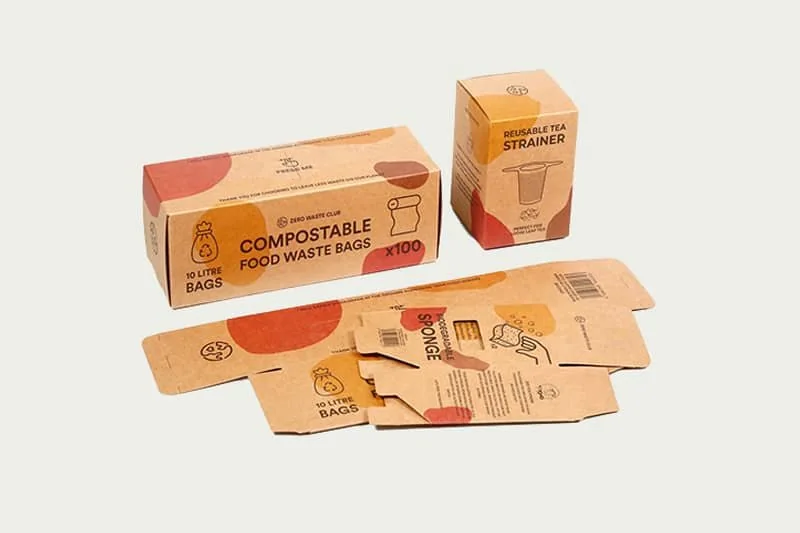
The folding-carton photo shows printed cartons both assembled and in flat blanks. It illustrates why carton suppliers can stack blanks densely before the packing operation. Actual freight savings depend on dimensions, carton count, packing and route.
Materials, structures and finish choices
For a rigid box, specify the measured greyboard thickness, wrap-paper grade, surface finish and any hinge or neck construction. For a folding carton, specify the paperboard grade and caliper, grain direction where relevant, print side, closure style and whether it will be packed by hand or machine. Using a gsm value alone to compare greyboard with folding-carton board can be misleading: thickness and stiffness are separate properties.
Both formats can use offset printing, foil stamping, embossing, debossing and spot UV. On a rigid box, print and finish are usually applied to the wrapping sheet before it is mounted to the core. On a folding carton, print and finishing are applied to the flat sheet before cutting and scoring. Therefore, artwork close to a fold, glue flap, hinge or wrap turn-in needs a different safety margin for each design.
Common mistake: A buyer approves a flat foil proof and assumes the finished formed box will match around its corners. Review a fully assembled sample for corner alignment, scuffing and lid fit. For cartons, check that coatings and decoration do not crack at a crease or interfere with a glue seam.
How the manufacturing routes differ
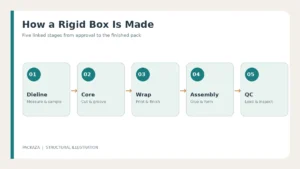
A typical rigid-box route starts with product measurements and a dieline, followed by a loaded sample, board cutting and grooving, corner forming, wrap printing and finishing, gluing and wrapping, insert fitting, inspection and export packing. Ask the supplier to identify inspection points at each stage.
A folding-carton route usually starts with the dieline and artwork, then paperboard printing, coating or decoration, die cutting and scoring, stripping, folding and gluing. The supplier may ship glued cartons flat. The buyer then erects and fills them by hand or on a suitable line. A closure that works in a hand sample may jam on an automated line, so test with the intended packing equipment.
Manufacturing judgment: If a carton needs multiple inner trays, sleeves and manual assembly to mimic a rigid gift box, its total packing cost may erase some unit-price savings. Conversely, a rigid retail box that is too large for its product adds board, insert material and freight without improving presentation. Set the product layout before fixing either outer box size.
Rigid box vs folding carton landed cost
Ask both suppliers to quote the same quantity and SKU mix, finished dimensions, artwork, finish, insert, packing method, destination and Incoterm. Separate sample/tooling, box, insert and freight. A basic unit-cost comparison misses carton erection labor, extra protective shippers and warehouse storage.
| Cost line | Questions for the supplier |
|---|---|
| Packaging production | What board, print, finish and assembly are included? |
| Tooling/sample | Which dies or plates are charged separately? Is the loaded sample production-standard? |
| Packing labor | Who erects, loads, closes and labels each unit? How long does it take? |
| Transport | How many units per master carton, with what gross weight and total CBM? |
| Damage allowance | What protection is included for the retail box and product in transit? |
For budget planning, use Packaza’s custom packaging cost guide. A fair decision uses total cost per saleable packed product at destination, not a box-only EXW price.
Protection and quality control
Neither construction replaces a complete transit pack. A fragile glass jar in a folding carton may perform well with a fitted insert and corrugated shipper. A heavy product in a rigid box may still move or scuff without a correctly designed cavity. Review the product finish, contact surfaces, voids, handling route and final master-carton packing.
For distribution-test planning, consult the ISTA test procedure overview and select a procedure that fits your route and product. Agree on the test configuration and acceptance criteria before the production run. A pass on an empty box says little about the loaded product.
The black book-style rigid box photograph below shows a hinged presentation structure. The image demonstrates its opening form; it is not evidence that every book-style box withstands a given shipping test.

QC checklist: For either choice, approve internal size with real products, print and finish reference, closure operation, visible surface condition and packed-unit inspection. With rigid boxes, watch corner seams, wrap adhesion, lid gap and hinge movement. With cartons, watch score cracking, glue integrity, folding accuracy and erected squareness. Inspect the first production units against the approved physical sample.
Which format fits your product?
Choose a rigid box if the product is positioned as a gift or keepsake, if the unboxing action is part of the value, or if a formed display cavity improves presentation. Choose a folding carton if shelf efficiency, lower storage volume, line speed or high-volume replenishment dominate. A hybrid can work: a premium rigid box for a limited edition and a printed folding carton for the everyday line. Use a common color and graphic system to keep them visually related.
Do not decide solely from category labels such as “cosmetics” or “electronics.” One lightweight serum bottle may suit a printed carton, while a fragile multi-item gift set may justify a rigid box and insert. Order both samples if the decision is close, then compare shelf appearance, loading time, loaded transit behavior and delivered cost.
Supplier questions and RFQ checklist
Send actual product samples or drawings; product weight and surface sensitivity; internal dimensions; target box style and opening; board and wrap preference; artwork and finishing; insert layout; expected quantity and SKU split; destination; required date; and whether filling is manual or automated. Ask for separate sample, tooling, production, packing and freight lines.
Ask each supplier: Does the bulk run use the approved sample’s materials and process? Which measurement points define fit? What is the first-article inspection plan? How are finished boxes separated in export cartons? Can you quote an alternative carton or rigid structure against the same product set? Packaza’s custom packaging options provide a starting point for box styles.
Frequently asked questions
Is a rigid box always stronger than a folding carton?
Its formed thick-board shell is generally stiffer as a retail package, but product protection depends on the whole pack. Compare loaded samples and the selected shipping test rather than board names alone.
Can a folding carton look premium?
Yes. Suitable paperboard, precise print, foil, embossing and a clean closure can create a premium shelf pack. A rigid box still offers a different weight and opening feel.
Do folding cartons always cost less?
Not for every assembled configuration. Quantity, board, finishing, insert, filling labor, shipping and damage rates all affect total landed cost. Quote the complete packed unit.
Can a rigid box ship flat?
Traditional set-up boxes ship formed. Some collapsible rigid structures can fold, but they add different joints and assembly steps. Ask to see a sample and a packing-volume estimate.
Which is better for e-commerce shipping?
Neither retail format alone is a universal courier shipper. The answer depends on product fragility, insert, outer corrugated carton and route. Test the final packed configuration.
How do I specify dimensions correctly?
State whether dimensions are internal or external, and identify the product orientation and clearance. Approve a sample with the actual product, insert and closure before releasing tooling.
What if my products vary by SKU?
Test the largest, smallest and most fragile configuration. A shared outer box with interchangeable inserts can simplify artwork and purchasing, but compare the added insert and assembly cost.
Can both formats use recycled paper?
They can be specified with suitable recycled-content board or paper, subject to performance and availability. Check the whole construction and local collection rules before making an unqualified recycling claim. For US marketing claims, see the FTC Green Guides summary.
Conclusion
The right choice between a rigid box and a folding carton depends on the desired presentation, filling operation and total delivered cost. Sample both against the real product, inspect the complete protective system and compare quotes on identical terms. Send Packaza your product dimensions, quantity, artwork and destination through the contact page to request a structure recommendation and a loaded sample plan.