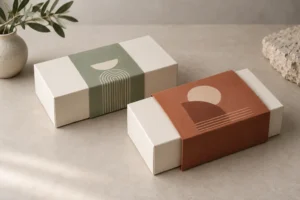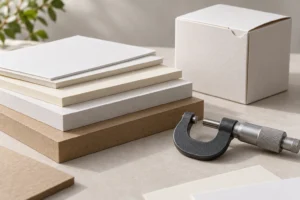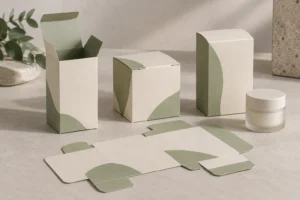
Foil stamping for packaging transfers a decorative layer to selected areas of a box or covering paper, commonly using a heated die and pressure. Buyers should confirm the process, foil grade, substrate and artwork together. A metallic preview cannot establish production quality: approve a representative physical sample for coverage, detail, alignment and handling before committing to the finished box order.
Key takeaways
- Specify the transfer process rather than requesting only a “gold logo.”
- Foil decoration and embossing are separate effects unless combined deliberately.
- Match the foil grade to the actual paper and base treatment.
- Give the printer a dedicated foil separation and matching print revision.
- Ask for process-specific detail limits and test difficult artwork.
- Separate tooling, setup, production and sampling costs in quotations.
- Retain the approved foil reference, files and finished sample for repeat orders.
What is foil stamping for packaging?
In hot foil stamping, a heated die applies pressure through a transfer material to place the decorative layer on the chosen surface. The design appears where the die contacts the sheet. The result may be metallic, pigmented or another specialty effect, depending on the transfer product.
The term does not mean applying a thick sheet of metal to the box. It also does not guarantee a raised design. A flat metallic mark and a mechanically embossed logo can look different and require different manufacturing specifications.
For a purchasing brief, move beyond the visual label: identify which surface will be decorated, which foil is intended and what evidence will establish acceptable production.
Purchasing principle: define the physical effect first, then ask the supplier to identify the compatible process and materials. Appearance, detail and durability cannot be approved from the word “gold” alone.

Which metallic effect and process should you choose?
Several methods can produce a metallic appearance. They are alternatives to evaluate rather than interchangeable descriptions of hot stamping.
| Option | What to discuss | Buying consideration |
|---|---|---|
| Hot foil stamping | Heated tooling, foil and substrate combination | Confirm detail, coverage and setup requirements |
| Cold transfer decoration | Adhesive-based transfer and press workflow | Ask whether the proposed surface and design suit the process |
| Digital foil enhancement | Specific digital transfer method | Confirm equipment, compatible surfaces and sample representativeness |
| Metallic ink | Printed metallic pigment effect | Compare a physical sample; appearance differs from transferred foil |
| Foil with embossing | Combined metallic and formed relief effect | Confirm tooling, registration and material suitability |
Gold and silver are common choices, but the exact shade and reflectivity matter. Obtain a supplier foil code and physical reference. A screen color or a general description such as “champagne gold” may leave room for interpretation.
If tactile relief is part of the design, use the embossing and debossing guide to distinguish formed paper from a flat foil mark. Ask whether the operations are combined or separate and how they will be aligned.
Avoid selecting a method purely from an assumed cost hierarchy. Quantity, design, stock and the supplier’s production route all matter. Ask for comparable proposals with the same intended outcome and clearly stated differences.
Which materials work with foil stamping?
Start with the surface receiving the decoration. For a wrapped rigid box, that is the covering paper and its treatment, not simply the greyboard underneath. Record both components in the box specification; the rigid box materials guide helps separate them.
Smooth coated art paper, textured specialty paper, kraft paper and laminated stocks can require different foil grades and settings. Do not assume the same transfer product will work equally well on every surface. Request a trial on the final paper and base finish where the combination is uncertain.
Texture can affect the continuity of fine lines or broad solid areas. The useful response is not a universal ban on textured stocks: review the artwork with the finisher and inspect a representative stamped sample. Simplifying fine details may be more effective than insisting on an unsuitable design.
Confirm the actual base treatment. Soft-touch coating and soft-touch film lamination are different surface systems. The soft-touch comparison guide can help clarify which one is proposed before foil compatibility is discussed.
For folding cartons, assess the decorated paperboard after creasing and folding. For rigid boxes, assess the wrap after assembly. A successful transfer onto a loose sheet does not establish the appearance of every corner, seam or moving component in the finished box.
If disposal, product contact or another application-specific requirement matters, request relevant evidence for the complete material combination. Do not infer suitability from a metallic appearance or a general claim about paper packaging.
How does the manufacturing process work?
A typical hot-stamping project begins with reviewed artwork and a selected foil/substrate combination. Tooling is prepared, the machine is set up, trial sheets are inspected and the decoration is applied before or within the agreed converting sequence.
Temperature, pressure and dwell time need to suit the transfer product, substrate and equipment. These are production settings to establish with the finisher, not universal numbers a buyer can safely copy from an unrelated guide.
The order of printing, lamination, stamping, die cutting and assembly varies by construction. Ask the supplier to explain the planned sequence and any effect on registration, creasing or adhesion. Record departures from the sample process before approval.
Common visual problems include missing transfer, unwanted foil in small gaps, rough edges and misalignment against printed elements. Ask the supplier which adjustments are appropriate for the material and artwork rather than assuming every defect can be fixed by increasing pressure.
Manufacturing check: sample the relevant sequence. If the final order is laminated, stamped and folded, approval of an unlaminated flat prototype leaves important questions unanswered.
How should you prepare foil stamping artwork?
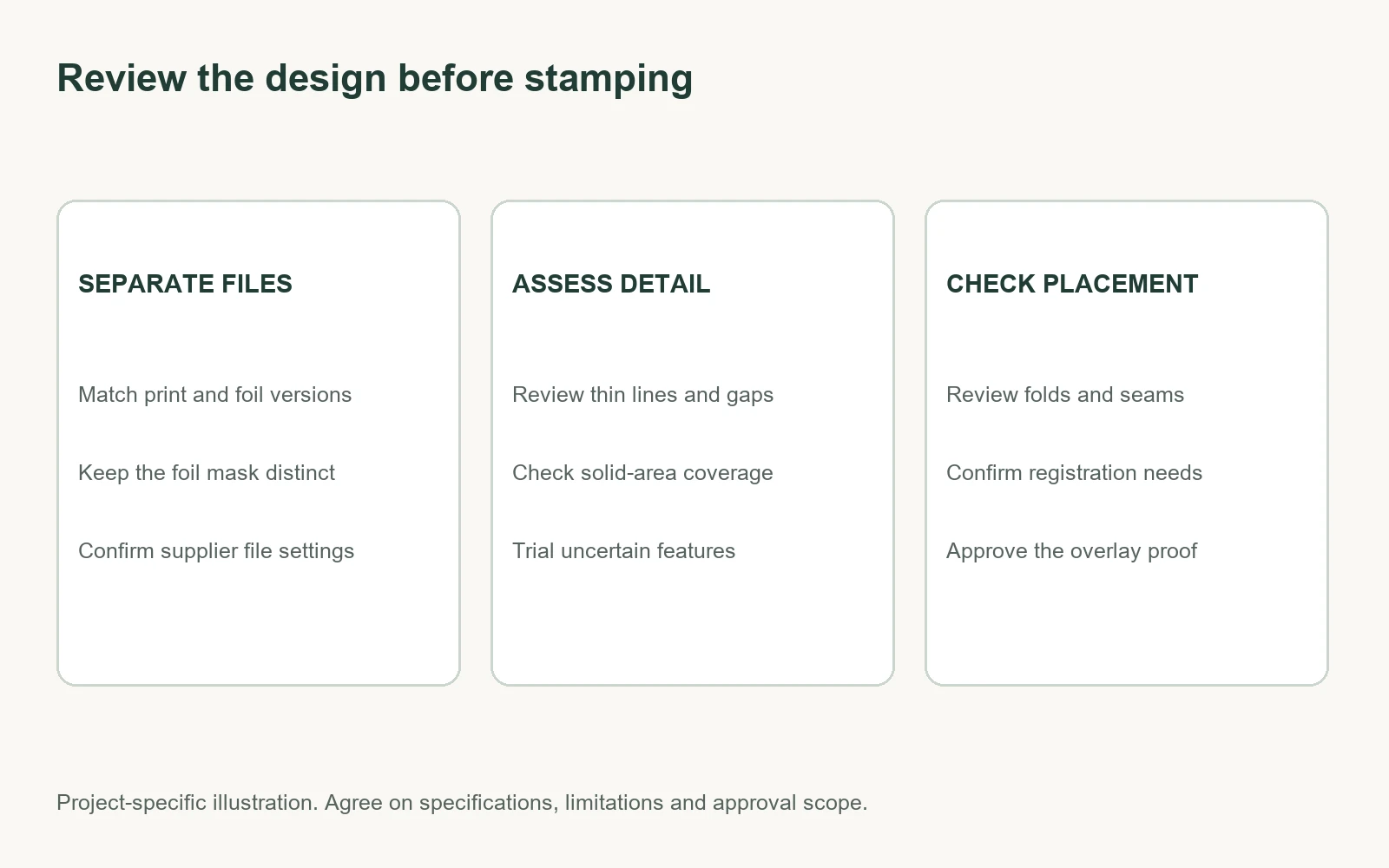
Provide a dedicated foil separation that identifies only the areas to receive foil. Keep its dimensions, orientation and revision aligned with the printed artwork. Ask the printer for its required file format, spot-color conventions and separation handling before exporting.
PrintNinja’s foil setup guide illustrates separate print and foil files and warns about fine artwork and registration. Its numerical limits are provider-specific. Use the chosen packaging supplier’s instructions for your stock, tooling and design.
Conventional hot-stamped artwork is normally defined by solid design areas rather than continuous-tone gradients. If the concept depends on shading or a photographic metallic effect, discuss a suitable printing or transfer route before sending a standard stamp mask.
Review small text, thin lines, narrow gaps and large solid areas. Ask for process-specific minimum features and a trial where detail is critical. A crisp PDF can still produce filled gaps or incomplete coverage on the actual paper.
Place decoration with the box structure in mind. Confirm clearance around cut lines, creases, wrap seams, hinges and glue areas. Do not apply a universal margin from a book-cover guide to an unrelated box. The packaging dieline guide explains the structural information to review.
Where foil follows a printed outline, discuss achievable registration and the visual consequence of variation. A self-contained foil logo may be more forgiving than one that must sit precisely inside a fine printed border. The supplier should assess the actual design, not promise perfect alignment without qualification.
Keep artwork revisions synchronized. If a logo changes size or position, update the foil separation and review tooling implications. Name files clearly and request an overlay proof showing how the print and foil relate.
What affects foil stamping costs?
The additional cost depends on the production route, tooling, number of foil applications, artwork, materials and order quantity. There is no universal price per logo that adequately describes every custom box project.
| Quote component | What to request | Why it matters |
|---|---|---|
| Tooling | Separate charge, ownership and retention terms | Defines repeat-order reuse and revision cost |
| Setup | Included operations and any separate passes | Clarifies what must be repeated for each order |
| Foil specification | Exact grade, shade and proposed substitutions | Keeps material and appearance comparable |
| Design scope | Approved mask, positions and foil colors | Avoids comparing different finishing requirements |
| Base packaging | Same paper, treatment and construction | Separates foil cost from unrelated box changes |
| Samples and revisions | Trial scope and correction terms | Reveals the cost of obtaining approval |
| Packing and delivery | Protection, master cartons and shipping terms | Identifies the delivered order scope |
Artwork revision can make existing tooling unsuitable. Ask whether a new die is required and whether the quotation includes it. A repeat order should identify the retained tooling and approved revision instead of assuming all setup charges disappear.
To compare an alternative, request the same box with and without the proposed foil decoration. Keep the base print and materials constant. Use the custom rigid box cost guide for the wider order budget.
If a budget is tight, consider simplifying the design or reducing the number of distinct foil applications, then obtain actual revised quotations. Less visible foil area does not necessarily produce a proportional saving because setup and handling may remain.
Include prepress, tooling, sample review and transport in the schedule. A production-time estimate alone may omit the approval stage. Ask for milestone dates rather than treating a single lead-time number as the complete launch plan.
What should foil sample approval cover?
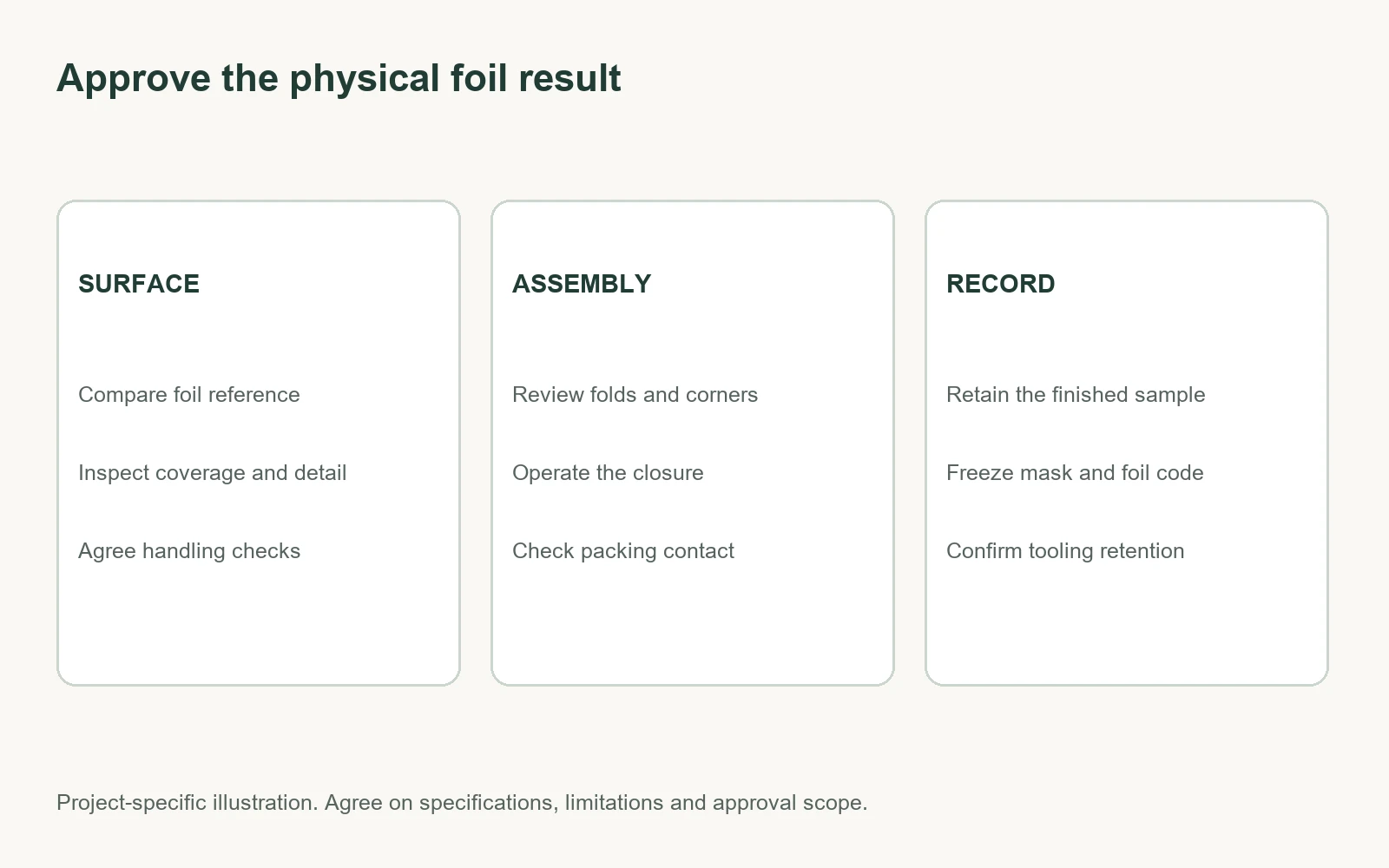
Inspect the sample in agreed lighting and turn it to see the reflective surface. Compare against the chosen foil reference, then check the decorated edges and the finished construction. Photographs help document findings but can distort shade and hide small defects.
| Review area | What to inspect | Evidence to retain |
|---|---|---|
| Appearance | Shade, sheen and coverage | Foil code and approved physical reference |
| Detail | Line continuity, gaps and edge definition | Artwork revision and close-up findings |
| Registration | Position against print and structural features | Agreed criteria and measurements where applicable |
| Surface integrity | Agreed adhesion or handling checks | Test method, sample identity and results |
| Finished construction | Folds, seams, corners and closure behavior | Finished-box revision and limitations |
| Shipment packing | Contact between decorated surfaces | Approved carton-packing arrangement |
Do not approve only the best-looking face if the design appears on several panels. Review all decorated positions and their interaction with the box construction. For combined foil and embossing, inspect both the metallic coverage and the formed relief.
Agree on appropriate handling or rub checks for the intended use. Specify the method and acceptance criteria with the supplier; avoid treating an improvised scratch demonstration as a formal durability test.
Review carton packing and storage contact. Decorated surfaces may touch other boxes, inserts or protective materials. Ask whether the packing arrangement preserves the approved appearance, then confirm it with representative handling.
Keep approval scoped to the evidence. A digitally rendered mockup may approve composition, while a stock foil swatch may approve shade; neither alone approves transfer quality on your final paper. Retain the finished sample, foil identity, mask revision and written decision together.
How do you compare suppliers and repeat orders?
Send suppliers the same box brief, substrate specification and foil mask. Ask each to identify the process, compatible foil grade, sample method and limitations. A proposal that quietly changes the paper or decoration process is not a directly comparable quote.
Request relevant examples, but distinguish a portfolio from your project trial. Ask how the supplier handles tooling retention, color references, incoming materials and proposed substitutions. General factory photographs do not establish the suitability of your design.
For repeats, reference the approved sample and files. Confirm whether materials, foil grade, tooling or production route have changed. Reopen the relevant approval when a change could affect the result, and agree on bulk inspection separately from sampling.
Use custom rigid box formats and the rigid packaging guide to choose a practical structure first. Foil should enhance that structure rather than conceal unresolved fit or assembly problems.
Frequently asked questions
Is gold foil made from real gold?
Do not infer precious-metal content from the appearance. Request the transfer product’s actual specification if composition matters to the project.
Is foil stamping the same as metallic ink?
No. One transfers a decorative layer and the other prints an ink effect. Compare physical samples to choose the intended appearance.
Does foil stamping automatically emboss the paper?
No. A metallic mark and a deliberately formed relief are separate specifications. Ask for a combined process if both are required.
Can foil be used on textured paper?
Some combinations work, but texture and artwork can affect the result. Ask for a suitable foil grade and a trial on the final stock.
Can I use very small text in the foil design?
Ask the finisher to assess the actual lettering, gaps, paper and process. Use supplier-specific limits and inspect a representative sample rather than assuming screen clarity proves feasibility.
Can an existing stamping die be reused?
Potentially, if the artwork, condition and production requirements remain suitable. Confirm retention, ownership and reuse terms with the supplier.
How much does foil add to packaging cost?
Request a quotation against the actual specification. Tooling, setup, foil applications, quantity and materials all affect the additional cost.
Can foil shade be approved from a screen?
Use a physical foil reference and representative finished sample. Lighting and display settings can make screen previews unreliable for metallic appearance.
Request a foil packaging quotation
Provide these details for a useful Packaza inquiry:
- Box format, usable dimensions and order quantities.
- Paper, board, wrap and base-treatment specifications.
- Print artwork, dieline and dedicated foil-mask revisions.
- Foil reference, shade and required positions.
- Any combined embossing or other decoration.
- Sample requirements and unresolved artwork details.
- Tooling ownership and repeat-order expectations.
- Packing method, destination and required delivery date.
Send the brief through Packaza’s inquiry form and request an itemized proposal. Confirm the foil and paper combination, review the artwork before tooling, and approve a representative finished sample. Keep the physical reference and production specification together so the decoration remains a defined purchasing requirement.