
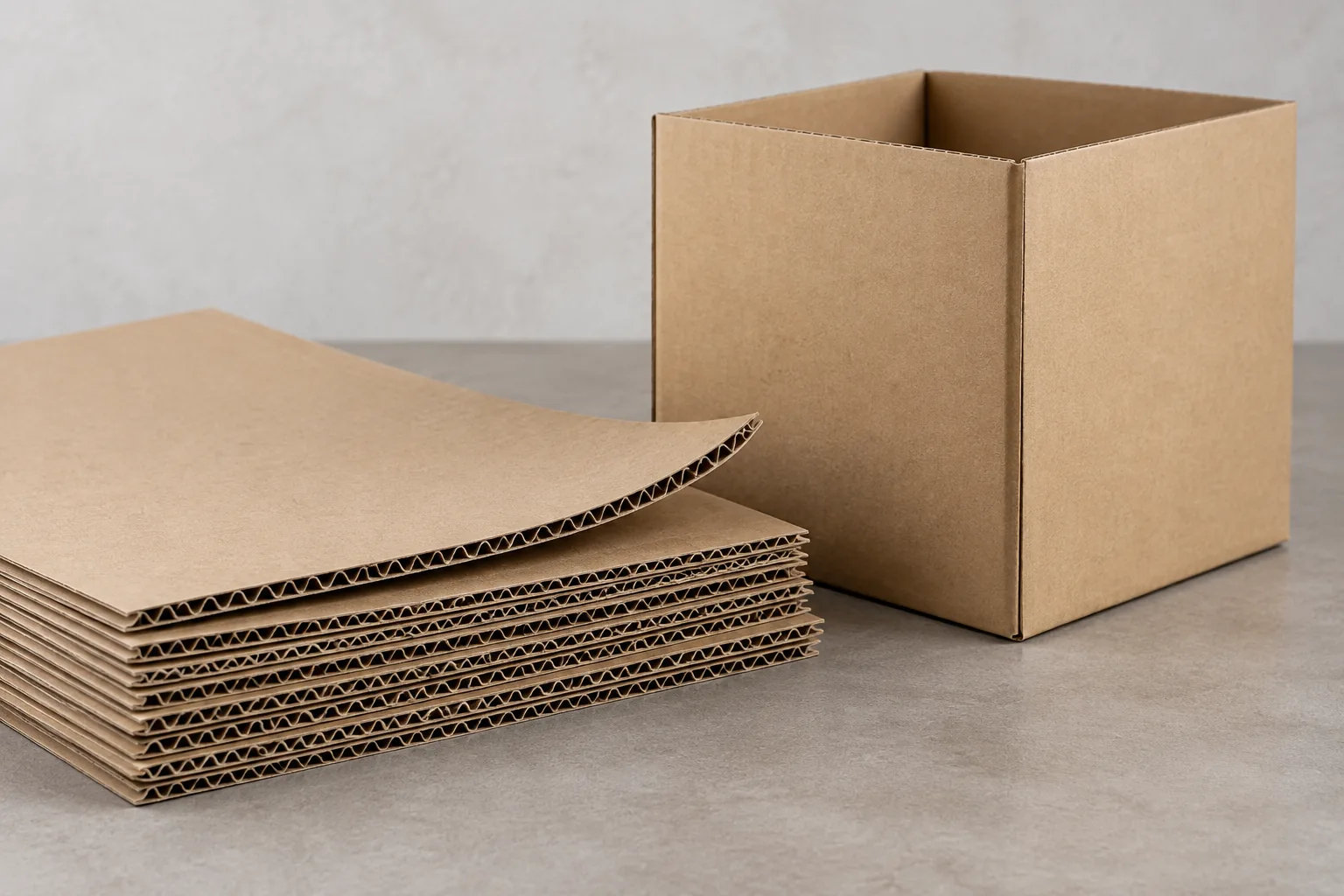
Corrugated board warp is a curve or twist in a sheet, not a complete verdict on the finished box. To buy boxes that run and pack reliably, identify the point where flatness matters, agree on a measurement method and sample condition, then check erected-box fit and closure separately. Ask the supplier to document an acceptable result for your board, box style and packing process; do not adopt an unexplained universal warp percentage.
Key takeaways
- Distinguish sheet warp from skewed folds, poor box squareness and out-of-spec dimensions.
- Describe when the defect appears: on arrival, after storage, during machine feeding or after erection.
- Agree on sheet size, conditioning, flat reference surface, measurement method and sample count before setting a limit.
- Check the finished box on the actual packing line or manual packing sequence, not only a loose sheet.
- Keep strength and shipment testing separate from flatness and squareness acceptance.
- Preserve the approved sample and record what triggers a new check after a material or process change.
What is warp—and why does it matter to a buyer?
Warp means that a corrugated sheet does not lie as intended on a flat plane. It may bow along one direction, across another direction, or twist. A visible curve is not automatically a failed box: the consequence depends on the sheet size, direction, box style, converting steps and packing operation. It becomes a purchasing issue when it disrupts feeding, printing, die-cutting, folding, stacking or the final carton’s fit.
The European corrugated association FEFCO’s Recommendation No. 110 provides a procedure for determining a warp factor of corrugated board articles. It explains that a simple warp percentage can vary with sheet size even for a comparable curve. The recommendation is a way to measure and compare, not a Packaza-wide tolerance or automatic pass/fail number. Ask your converter which measure is suitable for the actual blank.
The finished box has a separate question: does it erect squarely, close as designed and fit the product? A flat blank can still become a skewed box because of score, slot, fold or joint issues. Conversely, a slightly curved loose sheet may still convert and pack acceptably. Keep the blank and erected carton in the same approval record so neither is mistaken for the other. The Packaza packaging dieline guide explains why the approved structure and cut/crease positions matter alongside material choice.
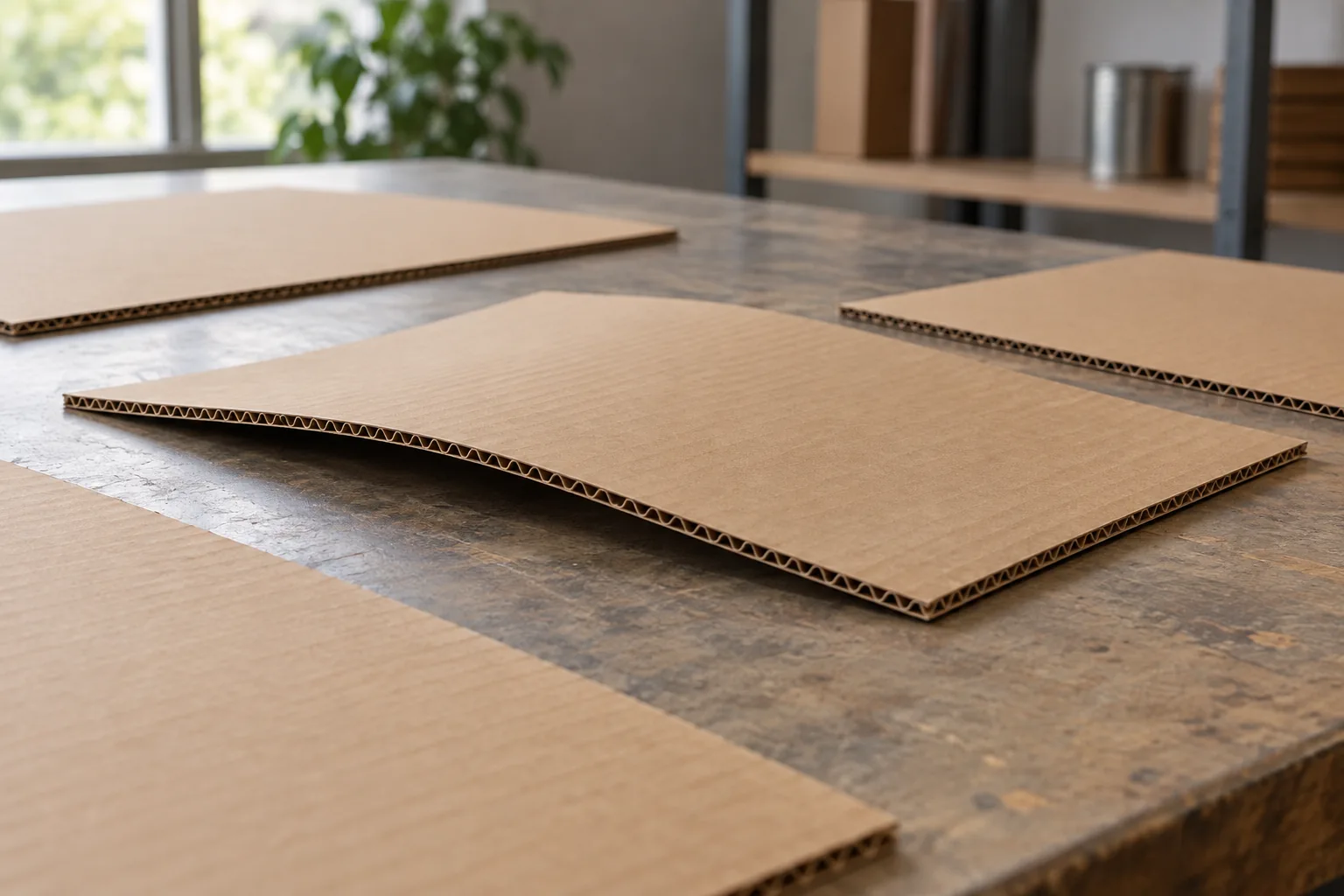
Generated concept image only; the visible curve is not a measured defect or specified tolerance.
Separate material condition from converting and storage effects
Corrugated board combines liner and fluted medium that respond to moisture and heat during manufacture. A FEFCO production handbook identifies moisture control as important to dimensional stability and prevention of warp or delamination. It also describes temperature and moisture controls during corrugation. That supports asking about process control; it does not identify the cause of a specific rejected shipment without inspection.
If the sheets look flat when produced but distorted after transport or warehouse storage, record the exposure before diagnosing the cause. Note whether pallets were wrapped, whether sheets were stored flat, whether a portion of the load was exposed to dampness and when samples were inspected. Avoid assuming every warped blank is a moisture failure: mechanical handling, stacking, material differences and conversion conditions may also be relevant. The supplier should investigate the actual lot rather than infer a cause from a single photograph.
For shipments in wet or humid routes, distinguish a flatness claim from the box’s strength under those conditions. The Packaza ECT-versus-BCT guide covers strength specification and testing; a board with the right strength rating is not thereby proven flat or easy to fold.
Define a repeatable flatness check
Start with the blank that is actually supplied. State its dimensions, flute and liner construction, print or coating, and whether it is inspected before or after die-cutting. Agree how samples will be drawn across a delivery rather than selecting only the flattest or most distorted sheet. Record the time since unpacking and the environment in which the sheet is checked; otherwise two parties may measure the same lot under different conditions.
FEFCO Recommendation No. 110 calls for a flat reference surface and measurement of the gap between that surface and the concave side, together with a chord length, to calculate its warp factor. It describes a procedure, not a universal acceptance limit. Have the supplier and buyer decide whether to use that method or another agreed measure, how to handle non-uniform twist and where to record the result. A photograph with a ruler can help describe a complaint, but it is not a substitute for a shared sampling method.
Write any limit against a real use case. A machine-fed flat blank may need tighter control than a manually erected box, but the allowable value depends on the feed path and specific blank. Run representative sheets through the intended process before setting a target that cannot be verified. If the package must fit an automated cartoner or a tight insert, specify that functional trial as its own acceptance item.
Check erected-box squareness and closure separately
Erect several finished boxes using the intended method. Observe whether walls stand as designed, opposing edges align, slots and flaps meet without forcing, the seam or locking tabs sit correctly and the product or insert fits. Compare inside dimensions with the approved specification. FEFCO lists a recommendation for determining internal dimensions of flap-type or one-piece corrugated cases; it is a reminder to use a defined dimension method, not to guess from outside measurements.
If a carton is visibly skewed, document where the departure begins: blank edge, crease, fold, joint, closure or loading. This prevents a generic “warped box” complaint from masking a cutting or folding issue. The Packaza box-dimensions guide gives a starting point for distinguishing internal dimensions from the outside footprint. For pallet packing, also compare the erected carton with the palletization guide; a square stack and safe overhang assessment require the actual packed box, not a flat sheet alone.

Generated concept comparison, not a Packaza inspection photo or a pass/fail demonstration.
Decide which evidence belongs in the order
| Buying situation | Primary concern | Evidence to agree |
|---|---|---|
| Flat blanks fed automatically | Misfeed or inconsistent registration | Blank flatness sampling and a representative line trial |
| Manually erected shipping cartons | Closure, product fit and stack geometry | Erected-box check with actual product and closure method |
| Long-distance or humid storage | Condition changes before use | Agreed storage/exposure record plus receipt and post-storage checks |
| Printed or die-cut display packaging | Panel alignment and visual quality | Approved finished blank, erected sample and artwork/structure comparison |
| Repeat order after liner, flute or supplier change | Old approval may no longer describe the lot | Change record and risk-based repeat of sheet and box checks |
Do not replace these functional checks with a board-strength number. Compression or impact tests may also be appropriate for the packed product, but they answer different questions. FEFCO’s testing-method list separately identifies sampling, board tests and package compression or drop tests. Choose them according to the failure you need to prevent.
Send a precise RFQ and acceptance brief
- Box style, internal dimensions, blank dimensions and approved dieline revision.
- Liner, flute, wall construction, print/finish and expected product load.
- Whether blanks are machine-fed, manually erected or packed by a third party.
- Delivery and storage conditions, including the inspection point and time after unpacking.
- Agreed sampling plan, flatness measurement method, sheet orientation and record format.
- Erected-box requirements for fit, wall alignment, flaps, seams or locking tabs.
- Functional packing trial and any separate compression, drop or transport testing.
- Who approves the initial sample, what constitutes rejection and what changes require reapproval.
Bring this brief to Packaza’s corrugated box team to discuss the box construction and a suitable sample plan. Any numerical flatness or squareness limit should be agreed for the specific order and checked on production-representative material; this guide does not claim a universal Packaza tolerance.
Frequently asked questions
Is a curved corrugated sheet always defective?
No. Assess the amount and form of curvature against the agreed measurement method and its effect on conversion, packing and the finished box. A visual curve alone is not a complete acceptance decision.
Is board warp the same as a box that is out of square?
No. Warp describes sheet shape. A box can be out of square because of cutting, creasing, folding or joint placement even when its blank was flat. Inspect both stages.
What warp percentage is acceptable for every order?
There is no responsible universal percentage. FEFCO explains that a percentage measure can depend on sheet size. Agree a method and limit suited to the blank and packing process.
How should we measure a warped blank?
Use a shared procedure with a flat reference surface, defined sample, orientation and conditions. FEFCO Recommendation No. 110 offers a warp-factor method; ask the supplier how it applies to the exact sheet.
Can humidity cause corrugated board to warp?
Moisture variation is one recognized contributor to dimensional instability. Investigate the actual lot and its production, transport and storage history before assigning a cause.
Does an ECT or BCT result prove the blank is flat?
No. Strength and shape are different properties. Use a flatness check and erected-box trial for the latter, plus strength testing where the packed-load risk calls for it.
Should we inspect before or after the boxes reach our warehouse?
Agree both the supplier’s release condition and your receipt or post-storage check if that stage matters. Record timing and conditions so results can be compared fairly.
When should an approved flatness requirement be revisited?
Review it when board construction, blank size, print or coating, converting route, packing equipment or storage conditions change. Repeat the checks affected by the change.