
GSM measures paper mass per square metre, while PT measures thickness in thousandths of an inch. They describe different properties, so there is no universal GSM-to-PT conversion. For packaging, request the exact board grade, grammage, caliper and relevant performance data together. Use thickness conversions only between thickness units, then validate the selected material in the actual box structure before approving production.
Key takeaways
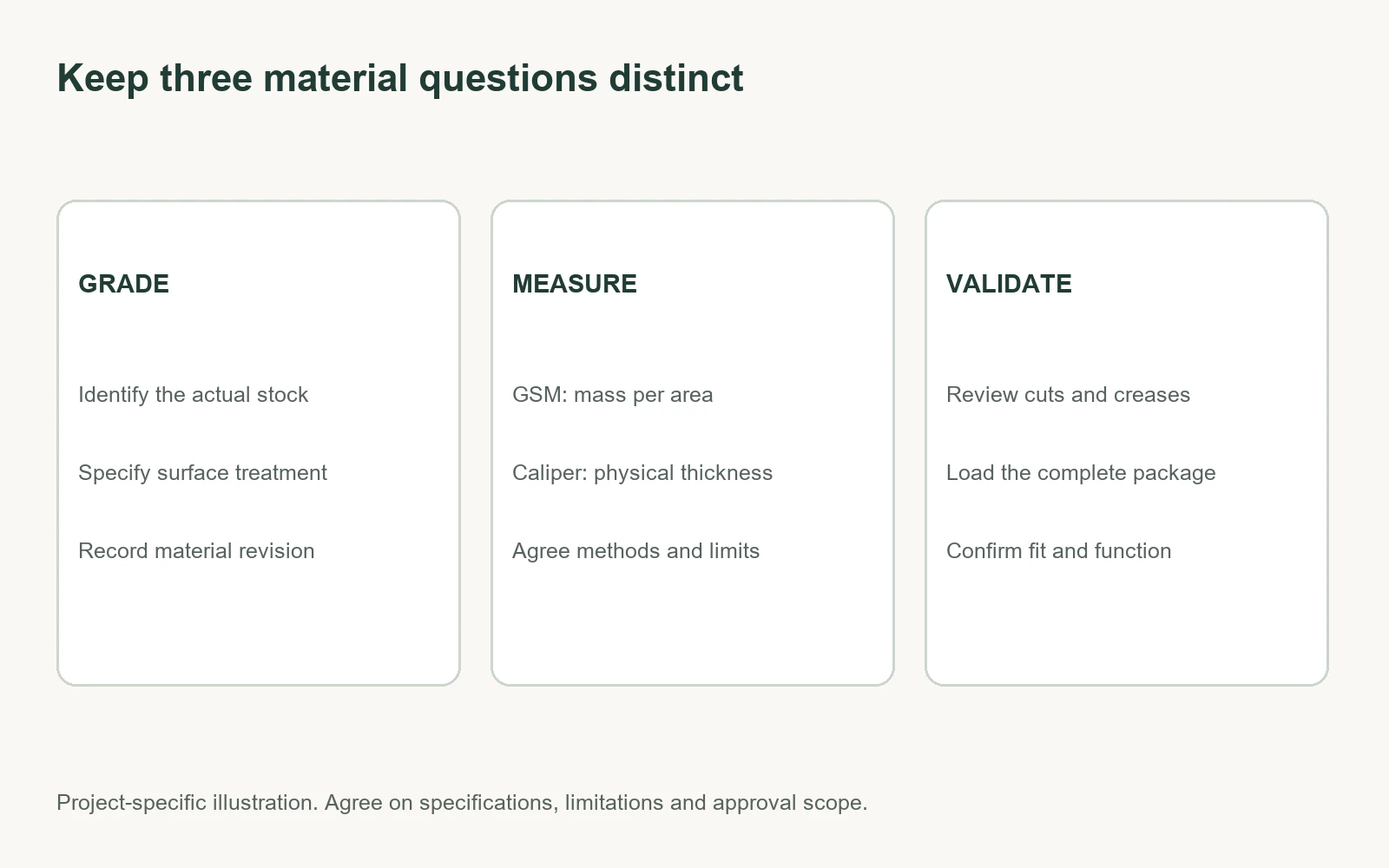
- GSM is mass per area; caliper is thickness.
- One paperboard point equals 0.001 inch, or 25.4 micrometres.
- Equal GSM does not guarantee equal thickness or stiffness.
- Equal thickness does not guarantee identical performance.
- Compare material grades and measurement methods alongside numbers.
- Separate rigid-box core board from covering paper specifications.
- Approve substitutions against the complete material and box requirements.
What do GSM and PT mean for packaging?
GSM, also written g/m², describes grammage: the mass of a sheet divided by its area. A 300 gsm stock has a nominal mass of 300 grams per square metre. It does not mean that every cut sheet weighs 300 grams.
PT describes caliper in paperboard purchasing. One point equals one thousandth of an inch. A 16 pt stock has a nominal thickness of 0.016 inch. This paperboard use of “point” should not be confused with typographic point sizes.
The purchasing distinction matters because a weight specification alone cannot establish a thickness requirement or the performance of an assembled carton.
Specification rule: identify the unit and the component. “300 gsm covering paper” and “1.5 mm core board” refer to different layers and cannot be treated as interchangeable box specifications.

Which paperboard units can you convert?
Thickness units convert directly. Mass per area does not convert directly into thickness without material-specific information.
| Nominal caliper | Inches | Millimetres | Micrometres |
|---|---|---|---|
| 10 pt | 0.010 | 0.254 | 254 |
| 12 pt | 0.012 | 0.3048 | 304.8 |
| 16 pt | 0.016 | 0.4064 | 406.4 |
| 18 pt | 0.018 | 0.4572 | 457.2 |
| 24 pt | 0.024 | 0.6096 | 609.6 |
These are unit conversions, not stock recommendations or guaranteed measured values. Multiply PT by 25.4 to obtain micrometres; multiply PT by 0.0254 to obtain millimetres. A nominal stock can still have an agreed manufacturing tolerance.
A generic GSM-to-PT chart is at best a reference for the material family behind it. Fiber composition, coatings and sheet construction can change the relationship. Ask for the selected grade’s data sheet instead of using an unrelated table to approve a substitute.
For example, a requirement for 0.40 mm caliper should remain a thickness requirement. Do not replace it with an estimated GSM and assume the supplied board will meet it.
Why does the material grade matter?
Paperboard is not defined by one number. SBS, folding box board, recycled grades, kraft stocks and greyboard can have different construction and properties. Identify the exact product or agreed material specification before comparing quoted grammages.
Stiffness is also distinct from thickness. Ask for relevant performance data where the project needs it, including direction and method. Holmen’s technical information identifies separate grammage and thickness measurements and reports stiffness with machine-direction and cross-direction distinctions.
Do not infer the strength of the whole box from sheet caliper. The package also depends on dimensions, creases, closure, seams, inserts and the distribution environment.
For rigid boxes, specify the supporting greyboard separately from the covering paper and lining. The rigid box materials guide explains the layers to include in the brief.
For corrugated packaging, flute construction and liners introduce a different structural system. A total caliper number alone does not fully specify the corrugated board. Avoid using a paperboard conversion chart as a corrugated strength specification.
How do thickness and box structure interact?
Caliper affects physical fit and converting. A change in stock can affect fold positions, tab engagement or usable space. Review the actual design instead of approving a thicker stock simply because it feels more substantial.
Specify usable internal dimensions separately from the finished exterior. For a wrapped rigid construction, include board, covering and lining layers in the manufacturer’s structural review. The product must fit the finished assembly, not only a nominal core dimension.
Check inserts and moving components as well. A material substitution can change a fitted insert or sleeve relationship. Ask whether the structural drawing needs revision and whether a new sample is necessary.
Use the packaging dieline guide to identify the approved cut and crease geometry. Keep the material specification attached to that revision so a drawing does not circulate without its intended stock.
Buying check: evaluate the loaded configuration. Higher GSM or caliper does not automatically solve a poor bottom design, unsupported product or unsuitable closure.
What changes in manufacturing and printing?
Ask the converter to assess the selected material for printing, cutting, creasing and gluing. Surface treatment and board construction can affect the result even where nominal thickness is similar.
Review grain direction and crease behavior with the manufacturer. If the material or caliper changes, existing settings and tooling may need review. A stock substitution is not automatically a drop-in replacement.
Printing depends on the actual surface, not just its weight. Compare white shade, coating, texture and the approved color reference. An artwork proof on another stock may demonstrate content while leaving final appearance unresolved.
For foil, embossing or other decoration, request a representative material trial where compatibility is uncertain. The embossing and debossing guide helps define formed effects, while the soft-touch comparison guide distinguishes base surface treatments.
Document what a sample represents. If it uses a substitute paper, approve only the features it can demonstrate and keep remaining material or process checks pending.
What affects paperboard material cost?
Compare the same material scope. Grade, grammage, sheet size, yield, print treatment, converting and order quantity all matter. A lower GSM is not automatically a lower completed-package cost.
| Quote item | What to request | Why it matters |
|---|---|---|
| Material identity | Grade, product code or agreed specification | Prevents comparing unrelated stocks |
| Grammage and caliper | Both values with units and tolerances | Defines weight and physical thickness |
| Sheet or blank layout | Size and yield assumptions | Affects material use and converting |
| Surface and decoration | Coating, film, print and finishes | Defines the complete material system |
| Samples and changes | Trial and revision charges | Reveals substitution approval costs |
| Delivery scope | Finished state, cartons and destination | Clarifies storage and landed cost |
For a nominal blank area of 0.10 m² made from 300 gsm board, the baseboard mass is 30 grams before accounting for other materials and losses. This illustrates grammage arithmetic; it is not the shipment weight of a finished package.
Use actual shipping dimensions and weight when assessing freight. CBM and container loading depend on the delivered packing configuration, not GSM alone. See the custom packaging cost guide for wider budget factors.
How do you verify supplier specifications?
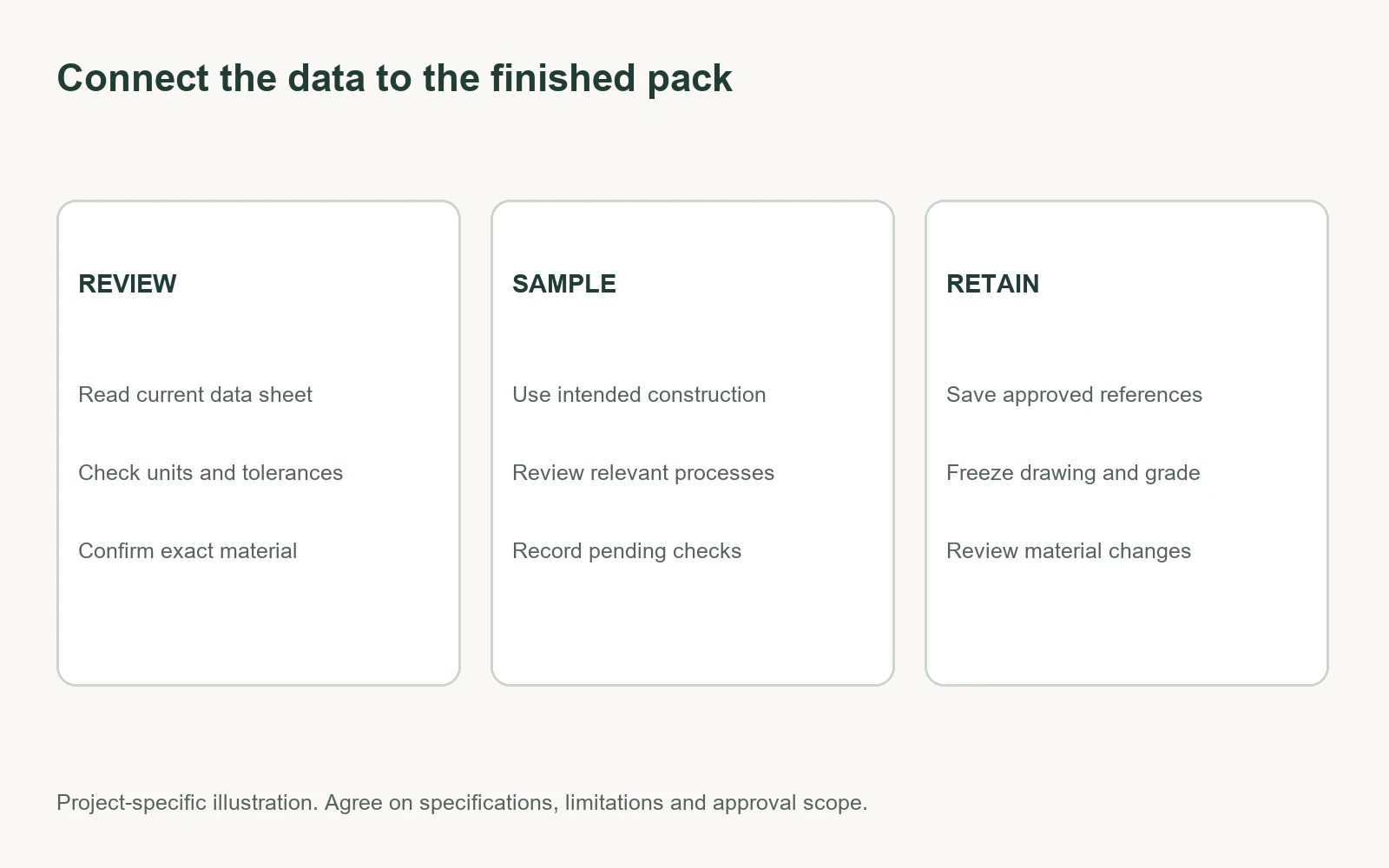
Ask for a current material data sheet and the relevant measurement method. Nominal values, guaranteed limits and typical data have different meanings. Clarify which values the purchase agreement requires.
| Check | Evidence to retain | Approval question |
|---|---|---|
| Material identity | Grade and lot reference | Is this the agreed stock? |
| Grammage | Value, tolerance and method | Does mass per area meet the specification? |
| Caliper | Value, tolerance and method | Does thickness meet the fit requirement? |
| Directional properties | Relevant data and direction | Does it suit the structure and converting? |
| Finished sample | Loaded carton and process revision | Does the actual package work? |
| Substitutions | Written change and review record | Which approvals must be reopened? |
Grammage and thickness are commonly evaluated through methods such as ISO 536 and ISO 534, respectively, as identified in the linked Holmen technical information. Referencing a method is not a claim that Packaza or a particular order has certified results.
A quick handheld reading may help identify obvious differences, but it is not automatically comparable to a laboratory or mill measurement. Agree on sampling, equipment, conditioning and acceptance criteria with the supplier or laboratory where measurements determine acceptance.
Retain a representative finished sample and the material revision. Inspect product fit, creases, closure and the intended handling separately from incoming stock checks.
How should you compare quotations?
Send suppliers the same component list, dimensions and performance brief. Ask them to identify proposed grades and substitutions. Avoid accepting a quote that supplies only “350 gsm premium board” where fit and construction require more detail.
For premium boxes, compare custom rigid box formats and the rigid packaging guide to define the structure first. Then specify its material layers.
For repeats, confirm that the grade, caliper, surface and process remain representative of the approved reference. Reopen relevant approval if a change can affect fit, appearance or function.
Frequently asked questions
Can I convert GSM directly to PT?
Not universally. Request the specific material’s caliper data; weight per area and thickness are different properties.
How many micrometres are in one PT?
One paperboard point is 25.4 micrometres, equivalent to 0.001 inch.
Is higher GSM always thicker?
Not across different grades. Material construction and density affect the relationship. Compare actual data sheets.
Is thicker board always stronger?
Thickness alone does not establish strength or box performance. Review the grade, relevant properties, structure and loaded configuration.
Should rigid-box covering paper and core board use the same unit?
They need clear component-specific specifications. Cover paper may be quoted by grammage while core board is also defined by thickness; obtain the details needed for each.
Can I use a retail conversion chart to approve a substitute?
Use it only as a rough reference. Approve against the actual grade, caliper, tolerances and finished-package requirements.
Is a micrometer reading enough to approve packaging?
It addresses thickness under its measurement conditions. It does not establish grammage, material identity or complete-box suitability.
What should a material quotation include?
Request grade, grammage, caliper, relevant tolerances, surface treatments, drawing revision, quantities and sample scope.
Prepare a packaging material quotation request
Include the product size and weight, box format, usable dimensions, component materials, required grammage and caliper, printing and finishes, quantities, sample checks and delivery destination.
Send the brief through Packaza’s inquiry form and request a proposal that identifies each material layer. Keep mass, thickness and performance distinct, then approve them together in the finished package. That gives the supplier a clear specification and reduces ambiguity when quotations or repeat-order materials change.