Packaging film lamination bonds a thin film to printed paperboard to change its appearance and surface behavior. Matte and gloss are visual choices, but the buying decision also depends on the exact film, adhesive, board, fold design and later finishing. Compare production-intent samples after converting into boxes, then record the approved film and acceptance checks. A digital mockup cannot establish scratch resistance, fold quality or glue-seam performance.
- Specify a named film construction and finish, not just “matte” or “gloss.”
- Compare both looks on the same printed board and under the lighting where the pack will be seen.
- Test dark solids, folded edges, glue seams, foil or spot effects on the final construction.
- Check fingerprints, scuffs and abrasion after realistic packing and handling.
- Ask how a laminated board will be separated, collected or recycled in the target market before making environmental claims.
- Approve a finished-box sample and retain the film, adhesive, board and artwork specification for repeats.
What film lamination is
Film lamination attaches a thin plastic film to a printed paperboard surface, usually with an adhesive or a thermal film system. It can change gloss, feel and surface protection. It is a distinct layer: an aqueous or UV coating is a liquid finish applied and dried or cured on the surface. Holmen Iggesund’s Graphics Handbook describes film glued to paperboard for visual effects and protection, and identifies smoothness, cleanliness and surface strength as important inputs.
The word lamination alone is not a complete specification. Film chemistry, thickness, adhesive system, print ink and board surface affect what can be produced and how the box behaves. Ask the supplier to identify the actual combination. A glossy sample from one film vendor is not automatically interchangeable with a different glossy film on a repeat order.
This article focuses on paperboard boxes, not flexible multilayer barrier packs. A thin decorative film on the outside of a carton does not by itself make a package leakproof, food-contact compliant or suitable for a specific shelf life.
Matte versus gloss: the buyer decision
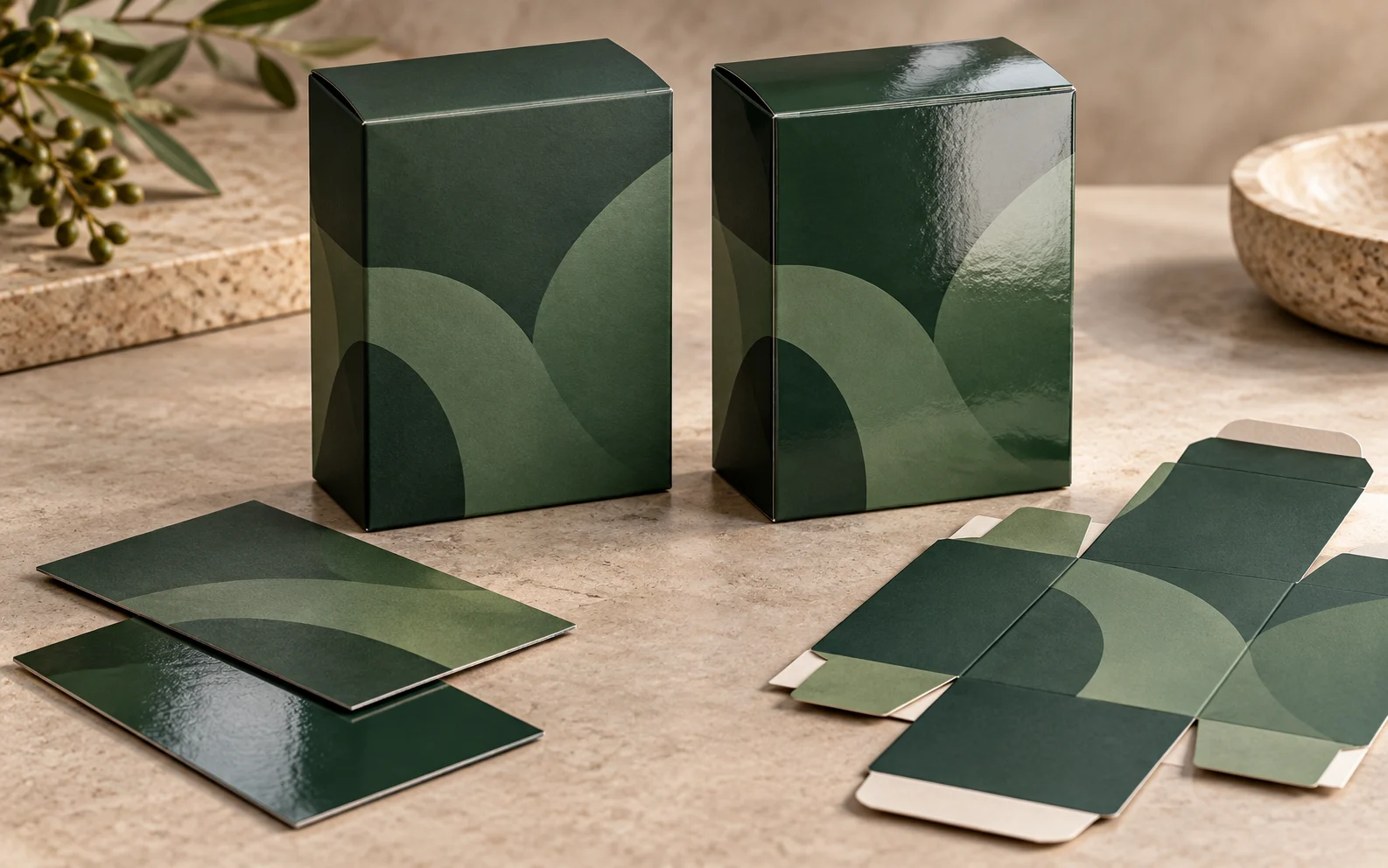
Gloss reflects light more directly and can make a printed image appear brighter in some conditions. Matte scatters reflections and can make a panel easier to view under bright shelf lighting. Neither finish is universally more durable or more expensive; performance depends on the particular film, its surface treatment, adhesive and handling environment. Compare real samples, especially when the brand uses dark solids where scratches or fingerprints may be conspicuous.
| Decision point | Matte film | Gloss film | Buyer check |
|---|---|---|---|
| Visual effect | Diffuse, lower-glare look | Stronger visible reflections | Compare under retail and unboxing light |
| Dark printed areas | May show rub or burnishing depending on film | May reveal fine scratches in reflected light | Handle, rub and inspect actual printed sample |
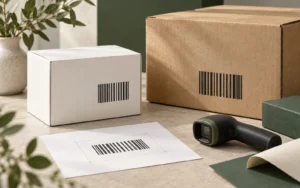
| Photography and scanning | Lower glare can help presentation | Highlights may alter photography or scanner response | Test the barcode and photograph the finished box |
| Later embellishment | Foil or spot UV compatibility varies | Same compatibility question | Request a combined-finish sample |
| Cleaning and fingerprints | Formulation-specific | Formulation-specific | Ask for a relevant test, not a blanket promise |
If the desired feel is velvet-like, compare specific soft-touch systems rather than assuming all matte films feel the same. Packaza’s soft-touch coating versus lamination guide discusses that narrower choice. If the aim is a local glossy accent rather than a full-film surface, spot UV may be another option to sample.
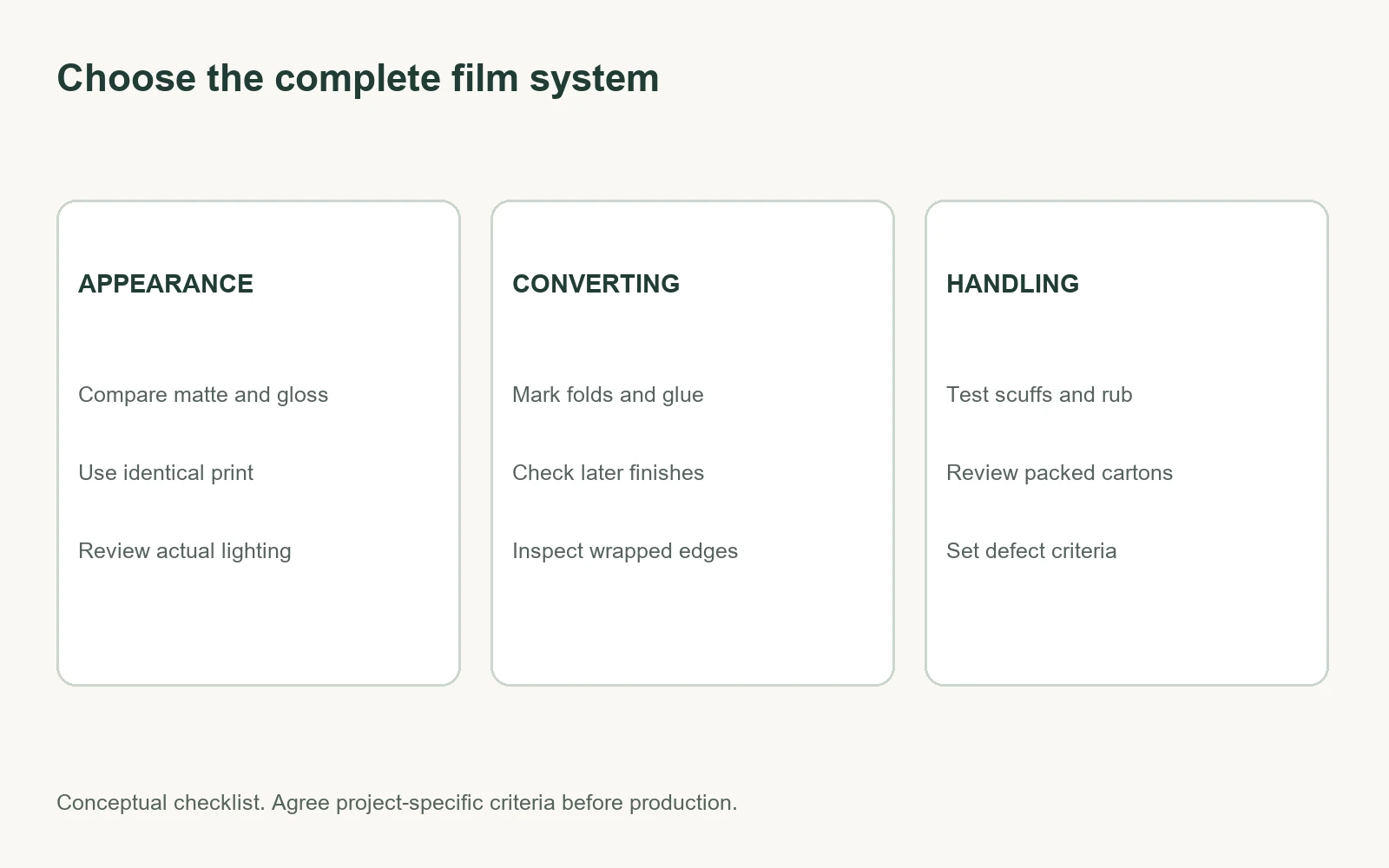
Film, adhesive and board specification
Ask the supplier to state the film type, finish, nominal thickness, adhesive or thermal system, intended board and print process. Different combinations can affect bond quality, curl, crease behavior and the appearance of dust beneath a glossy surface. The Iggesund handbook notes that film lamination requires a smooth, clean paperboard base; irregularities become more visible at high gloss. It also describes the importance of controlling moisture during glue lamination to keep products flat.
Board identity matters as much as the film. A coated art-paper wrap over a rigid greyboard box is not the same substrate as an uncoated folding-carton sheet. Ask for board grade, caliper and print-side coating. The GSM versus PT guide explains why paper weight and thickness should be specified separately. If a supplier changes a board or ink, request a new compatibility sample rather than reusing an old approval unquestioned.
Do not infer food-contact suitability from a statement such as “water-based adhesive” or “BOPP film.” If a packaging component may contact food, cosmetics or pharmaceuticals, obtain the relevant application-specific documentation and have the responsible regulatory team review the complete printed and converted structure. This article makes no compliance determination.
Structure, folds and glue seams
Boxes are converted after printing and often after lamination. At scores and corners, a film can lift, bridge or crack if its combination with the board and crease geometry is unsuitable. The carton may also resist folding or spring open. Test the actual dieline and intended grain direction on a complete sample, not only a flat laminated sheet. Use the approved dieline and physical sample as the controlling references.
A glue seam is another critical area. Adhesive applied to a laminated surface may require a different method or a deliberately unlaminated glue flap. The Iggesund handbook identifies film-laminated surfaces as more demanding for gluing and discusses side-seam gluing in packaging. Ask the supplier how the film is kept out of glue zones, what adhesive system is used and how bond strength will be checked. Do not accept a beautiful flat proof as evidence that the box will stay closed.
| Finished-box area | Possible issue | Sample check |
|---|---|---|
| Score and fold | Film lifting, cracking or stiff fold | Repeatedly fold the actual carton and inspect edges |
| Glue flap | Weak bond if film reaches the adhesive zone | Check glue exclusion and seam after conditioning |
| Wrapped rigid-box corner | Wrinkle, lift or mismatch at edge turn | Inspect assembled corners and handling wear |
| Window, perforation or die-cut | Film bridging or rough edge | Check cut quality and opening function |
| Dark exterior panel | Visible scuff, rub or fingerprint | Inspect after agreed packing and transit simulation |
For rigid boxes, the printed and laminated wrap is mounted to greyboard and turned around edges. Approve the finished wrapped form. The rigid box manufacturing guide explains why the mounting sequence changes what the customer sees.
Printing and additional finishes
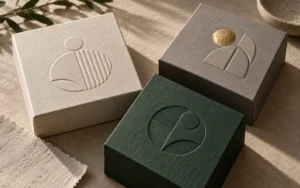
If the artwork contains dense ink, metallic effects, foil, embossing or spot UV, ask for a combined-finish sample in the final sequence. Lamination can shift perceived color and reflectance. Later hot foil or spot coatings may need a film surface designed to accept them; the supplier should confirm adhesion and registration for the actual construction. Avoid stating that every matte or gloss film supports every embellishment.
Keep functional graphics in the approval. Barcodes may need a low-glare, high-contrast area and verification on the assembled package. Print color should be reviewed after the final film, since a flat ink proof alone cannot establish the final appearance. When color is critical, retain the approved printed and laminated sample as the visual reference.
Discuss which panels truly need film. A selective finish or unlaminated inside can sometimes meet the visual goal while simplifying gluing or material separation, but the result depends on the available print and converting process. Ask for both options with the same board, quantity and finished-box criteria.
Sample and production workflow
- Define the use. Describe retail display, e-commerce handling, product weight and expected rubbing or stacking.
- Choose candidate finishes. Request named matte and gloss film samples on the same printed board and ink set.
- Mark functional zones. Put film boundaries, glue exclusions, scores, windows and later embellishments on the current dieline.
- Make production-intent samples. Use intended film, adhesive, board, print and converting sequence; record any deviation.
- Inspect the finished pack. Compare light reflection, scratches, fingerprints, bond, folds, seams, edges and color after normal handling.
- Approve a master. Label the physical sample with film, board, ink, adhesive, artwork and dieline revisions.
- Check production. Review first-off pieces and agreed in-run pulls against that master. Reapprove material substitutions.
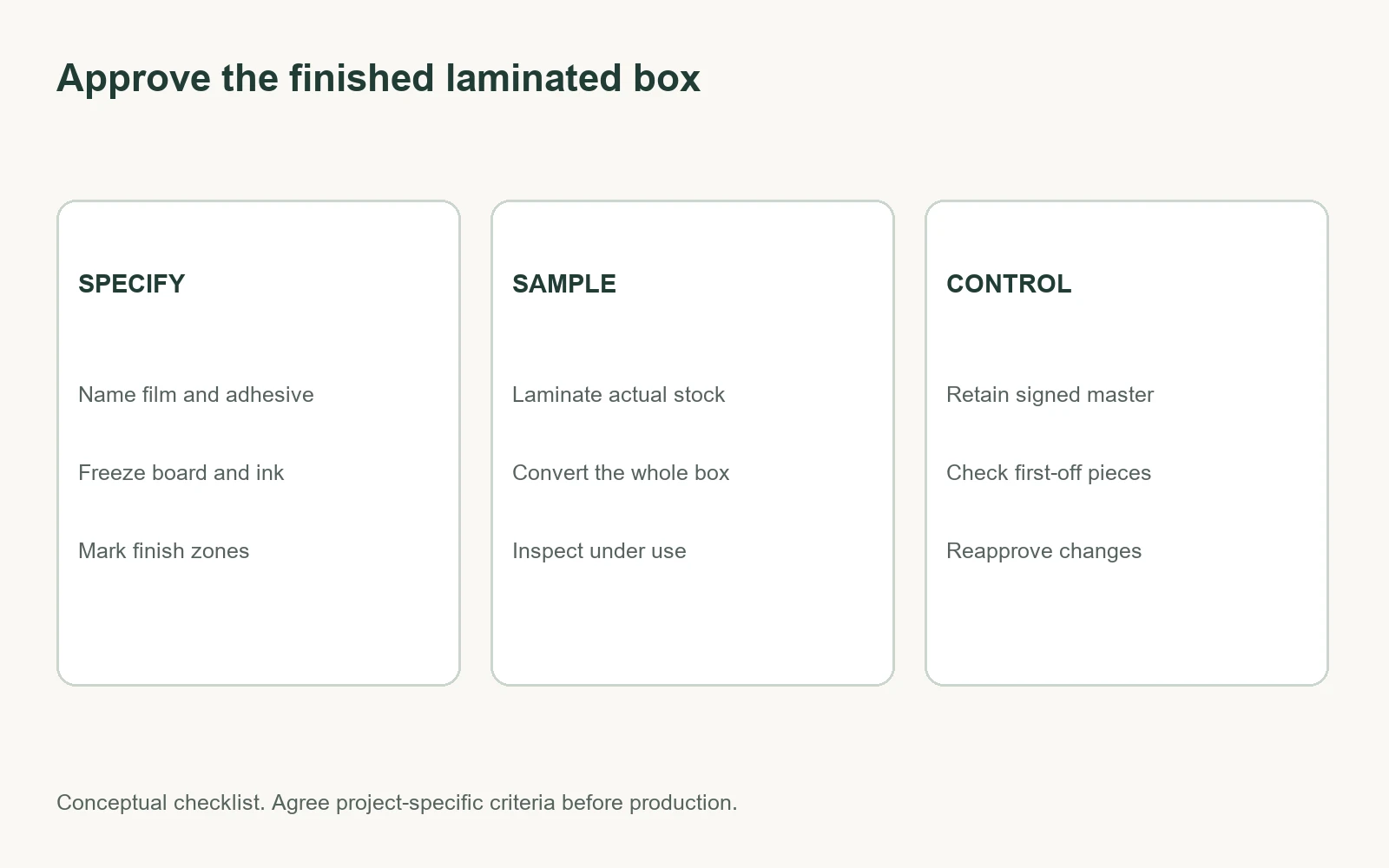
If your shipment plan includes tightly packed cartons or stacked finished boxes, put samples through a representative packing and handling trial. A film that looks flawless on a showroom sample may mark where two boxes rub in an export carton. Agree on what level of scuffing is acceptable before comparing suppliers.
Cost and supplier comparison
Film, adhesive, lamination setup, waste, samples and later converting can all influence the quote. Prices also depend on coverage area, sheet size, quantity and whether one or both sides are laminated. Ask suppliers to separate these components and state what the price includes. A lower unit price is not necessarily the lower landed cost if a weak glue seam or surface scuff leads to rework. The custom packaging cost guide covers other quote variables.
Compare equal specifications. A basic matte film, an anti-scuff matte film and a soft-touch film are not the same product merely because all look low-gloss. A gloss film with different surface treatment can also perform differently. Request the actual film identification, production-intent sample, quality plan and replacement policy if an approved film becomes unavailable. Do not adopt Pakoro or another supplier’s broad “lamination is always more durable” claim as a project guarantee.
Quality and end-of-life checks
QC should cover adhesion or delamination, bubbles, wrinkles, trapped dust, curl, shade or gloss inconsistency, scuffs, fold edges and glue-seam integrity. The sample plan should identify where checks happen: flat sheet, converted box, packed carton and—if needed—after a shipping simulation. If a numeric bond, gloss or abrasion target is required, the buyer and supplier should agree on the method and acceptance range for this exact combination before production. No single universal value fits all packaging.
Film adds another material to the paperboard. That can affect collection, sorting and repulping, but actual outcomes vary by local system and specific film/adhesive construction. Ask the supplier for the material breakdown and ask the target market’s recycler or an appropriate test program before claiming the finished box is recyclable. A decorative film should not be described as a waterproof barrier or food-safe layer without evidence for the complete package.
Quote checklist
| Information to send | Why it matters |
|---|---|
| Box style, dimensions, product and quantity | Sets structure and handling requirements |
| Board grade, caliper and print side | Defines the base to be laminated |
| Print artwork, ink and color reference | Allows final color and adhesion assessment |
| Named film, finish and thickness | Prevents a vague “matte” or “gloss” substitution |
| Adhesive or thermal system | Connects film to bond and flatness |
| Dieline, folds, glue zones and windows | Reveals conversion risks |
| Foil, spot UV or embossing layers | Defines later compatibility tests |
| Sample and QC criteria | Makes acceptance and repeat orders measurable |
If you are still choosing the box architecture, browse custom rigid boxes and compare them with a folding carton before deciding on the decorative finish. Lamination should support the package’s purpose, not substitute for an adequate structure.
Frequently asked questions
Is matte lamination always less prone to scratches?
No. Surface formulation and handling matter. Some matte films show burnishing or rub marks, while some gloss films reveal fine scratches in reflections. Test the named films with your printed artwork.
Does gloss lamination always make colors brighter?
It can change perceived depth and contrast, but the outcome depends on print, board and lighting. Approve a laminated color sample, not a screen simulation.
Can a laminated box still be folded?
Yes when film, board and creasing are compatible. Check the intended score and fold on a converted sample for lifting, cracking and spring-back.
Can I glue over laminated film?
Sometimes with an appropriate surface and adhesive, but a glue-free film zone is often simpler. Have the converter specify and test the actual seam.
Is laminated paperboard recyclable?
It depends on the full material construction and local recycling system. Request the film and adhesive specification and verify acceptance in the intended market before making a claim.
Is lamination waterproof packaging?
No blanket claim is justified. A laminated exterior may resist some surface contact, but folds, seams, cuts and the rest of the structure remain relevant. Test for the actual exposure if water resistance is needed.
Can foil or spot UV be applied on top of a film?
Compatibility depends on the chosen film, adhesive and finishing process. Request a combined-finish production sample and check adhesion and registration.
What should be recorded for repeat orders?
Keep the film identification, finish, thickness, adhesive, board, ink, dieline, approved physical sample and defect criteria. Reapprove when any component changes.
Specify the finished box, not just its sheen
Matte or gloss is only the start of a lamination brief. Define the complete film and board combination, test the converted box and document what acceptable handling looks like. Send the checklist above when you request a Packaza packaging quote, and ask for both finishes on the same production-intent stock if the visual choice is still open.